Once upon a time I went to a show and it was called Orlando. It was at the Court Theatre. It was a story about a boy that turns into a girl, and it was also about how you can love women even if you are a woman. It took place in a lot of time periods; to be precise, the Elizabethan, the 19th century, and the 20th century. Orlando is mostly thirty for the play even though she/he has lived through all these different centuries. At the very beginning he is sixteen. There is a male chorus; they played different characters. The director, Jessica Thebus, made them play some women parts too because this was a play about men and women put together and how they connect to each other. It is based on a book by Virginia Woolf. She wanted to tell people that you can marry people that are the same sex and that people can feel like boys if they are girls and feel like girls if they are boys. What happened to Orlando couldn't really happen in real life because she is alive for centuries. Most people are only alive one century.
The Queen Elizabeth was played by Lawrence Grimm. I thought he did a good job playing the Queen because he was a boy and the character was a girl. He was so funny. The Queen was like "kiss me," and then Orlando kissed her and she said "That's my boy!" I felt kind of sorry for her when Orlando kissed the other girl.
There was a scene where Orlando was in the bed with the Queen. And the chorus was outside of the bed and said, "And the flower bloomed and fa-ded. The sun came up and back down again." That was funny because they were like dancing at the same time. Their arms were up, and they were on their tippy toes, and when they said faded they put their arms down.
In the book they said that the girl that Orlando was supposed to marry (Thomas J. Cox) was dropping as many handkerchiefs as she had but Orlando would only pick up Sasha's handkerchief. In the play, she threw so many handkerchiefs and said "Orlando! I'm dropping my handkerchiefs! Will you pick them up! Hellooo!" That was how I imagined it in the book except I did not think it was going to be played by a boy.
Sasha was played by Erica Elam. Sasha was a Russian princess. I love how she was like "Translation: Will you please honor me by passing the salt." She was always speaking in French but she had a Russian accent. She did a very very good Russian accent. She was going to marry Orlando but then she went away on a ship with sailors played by the chorus. She should have stayed with Orlando but maybe her father was worried about her and she had to go see him. Maybe it was for a good reason.
When the big flood happens there was a couple laying in bed with millions of eating utensils. I love that part because it is so hilarious.
There was a scene of Othello by Shakespeare in the play that Orlando saw. I thought that it was a very good adaptation of Othello. And who played Othello was Kevin Douglas. Orlando was thinking that he had murdered Sasha with his own hands. But he did not. He was just imagining. He was imagining it because Othello is about a man who suffocates his wife because of the handkerchief but she did not really give it to another man that she is actually not in love with. Othello feels really bad and kills himself.
The actor that played Orlando was named Amy J. Carle. When she was a boy she just wore her hair up in a bun--very easy. I thought she did a good job at playing a female and male part--even though they were the same part. There was a flies game that they played that the Duke that was playing with Orlando (Cox) had to give money to her because whoever had the flies on the lump of sugar that they thought got the money. So it was like gambling. She was like "Ah! Ah! A fly!" and then she got his whole entire fortune. But then he was like, "I can forgive you with my charmingness." And she was like, "Oh no. Not again!" I felt that when she actually speaked to us (not just speaking to a character) it was cool because it made you feel like she didn't just care about the people in the story, she cared about the people watching.
The scene where she changes into a woman was a cool part because the chorus said "And she stands in front of all of us in complete nakedness." You saw her behind a curtain, but you knew she was naked. It tells you that she is a woman. It was not surprising because I had read that part of the book.
In the play, the chorus said "And he did what any young man would do." And Orlando says "King, please send me off to Constantinople" because he wants to get away from the Archduchess (Cox). And he does get away from the Archduchess--for a century. Most people would think that was good, but not Orlando because she lives more than a century. She changes into a woman and comes straight back to London and she meets the Archduchess and then he turns into the Archduke. He revealed "A man in black," and then said: "I was in love with you when I saw your picture, but I knew I could not marry you because you were my same sex." Then he turns into like a hilarious pose. Orlando is not impressed at all. The Archduke did like a lot of teeheees. The chorus said: "with an unmentionable number of tee heeing and haw hawing." She said, "Have you ever shot a Tiger?" And he said, "No, but I shot an albatross." Like duh. It is much easier to kill an albatross than a tiger. If he had shot a tiger, I would be like, I will marry you. Because that would be very useful.
Now let's talk about the Captain (Kevin Douglas). When Orlando is a woman she meets a Captain, and he says, let me give you the smallest slice of corned beef, just the size of your fingernail." It was funny because women's fingernails are smaller than men's. So that is a very small slice! She says, "The only thing to do was to resist or yield." And she yielded. There is a part they left out where a sailor is at the top of the mast, and he sees her ankles, and he almost falls off the mast. They didn't have anything to be a mast, and it would be kind of dangerous for the actors because they might fall and break their heads. That is why they did not put in that part.
They also left out the horrible-est character in the world--Greene. I did not like him because he wrote a horrible poem about Orlando. The playwright Sarah Ruhl left him out because I think he was such a bad character and she just didn't want to make people feel too too too bad for Orlando.
Now let's talk about Shelmerdine. Adrian Danzig was Marmaduke Bonthrop Shelmerdine, Esq. And everyday at breakfast, he told Orlando his name. And she is like, what's your name again? He is the husband of her. He is like "I think you are a boy," and she says "You are a girl." And then they said, "But we have to prove it," and they kissed. And it looked like they were going to wrestle. And I have no idea how that would help. The kissing helped in that time because girls could not marry girls and boys could not marry boys. Now they can. Their relationship was like a really good relationship because they liked the same things. And there was this scene where she read his mind about what he did, and where he lived, and what he liked.
The set was designed by Collette Pollard. I though the set was cool because they could move around the set. So they could use the bed as a lot of things: a ship, a bed, and a flower bloomed and faded place. It was really elegant. The costumes were made by Linda Roethke. I thought they were cool because when they said "And it was the Elizabeth times" they put on ruffle-necks. The costumes had lots of velcro and zippers--no buttons because most of the people were different parts easily. And buttons are hard to get on and off. They had different time period outfits because Orlando lived through so many different centuries.
People who would like this play are people who would like a long amount of kissing, and people that like boys and girls would like this play. You should expect nakedness. You should expect some funniness and some sadness. I laughed twenty five times out loud. When they did Othello, I felt very moved. And when Sasha left I felt very very sorry for Orlando. This play is more hilarious than sad though. I recommend that you should read some of the book before you see the play but not all of it because I think people would like the surprises. You should go see this because it is a very good adaptation of Orlando.
I went to this play, and it was called Master and Margarita. It was at Strawdog Theatre Company, and it was a very creepy play. There were so many characters in it that I couldn't keep track of all of them at the same time. The play was fun, heartbreaking, and silly. And there were a lot of scary parts in it. People's heads got chopped off. It was so fun because there were these scary parts and these not scary parts. I thought it was great.
There was a whole entire magic thing, and the devil Woland said at the party that he was actually not a magician--he was a devil. Devils can do magic, but most magicians cannot do real magic. They were doing magic tricks on the stage, but the devil Woland was doing actual magic. Magic tricks are not actual magic; they are just things that people believe are actual magic, but they are not. I thought the actors did a great job doing the magic tricks, and most people believed it was real magic.
Tom Hickey played the devil Woland. The devil Woland was a cool and crazy character. I don't mean like crazy like blublublublu. I mean like crazy like "I can make this hat into a marshmallow! Now I'll pull marshmallows out of this marshmallow! Now everybody can have a marshmallow!" Magic crazy. One of his eyes was blue, and one was brown. The devil looked creepy with that. He seemed to kind of be a good person but he did some things that were bad. He did stuff that was great but terrible. Like in Harry Potter. He told Master and Margarita how to live forever, and that was good. He killed somebody, and I did not like that.
The Master was played by Dennis Grimes. When he met Margarita, that was the kissing part. There was a lot of kissing. They just met and--bup a dah!--they were in love! It felt like they were in love because he picked up the flowers for her, and when you are in love you just do stuff for the person that you love. And he did a lot of cool stuff like when he said, "Your nurse is very kind, but mindless." The nurse was played by Shane Brady. I thought he was funny because he dressed up like female nurse. Everybody did know that he was not a girl because he had some of a beard, and his feet were too big for the shoes, and he had hairy legs, and he wore a wig.
Margarita was played by Justine Turner. Justine was very good when she gave him the cap--she looked very excited, like she was really going to give someone a present. Margarita was sometimes really loving The Master, like when she was helping The Master to calm down. She was the queen at the death party, and she got in return The Master. There was a scene where Margarita set Frieda (Christy Arington) free and forgave her for smothering her baby. That's how it was shown that Margarita was very kind. I did not know what smothering meant when I saw it, but now I know and it makes me feel sad. There was this part where there was this golden ointment. And it made Margarita's skin shine, and then her servant (Sarah Goeden) got it on too and came to the Devil with her pig. It is cool because it was supposed to be golden. At least Margarita wasn't all the way naked. They said take off all your clothes, but she didn't. Just some of them, luckily.
Andy Lawfer played the cat. And the cat's name was really long--Behemoth--that's a pretty long name. It kind of sounds like "be my myths" because some of the stories that The Master likes are myths. There is lots of magic in myths and in this story it was kind of a myth and kind of not myth. What was not mythical about it was that writers can write about Jesus. A giant cat named Behemoth is mythical. They named him Behemoth because he was not just a regular cat--he was like an ax-murderer cat because he cut off people's heads. He does kill all the bad guys so that makes him a hero--he's like the superhero of the story. There's nothing that he really does bad. Because he works with devil-- that's why everyone thinks he's baaaad.
Loretta Rezos, she played the prettiest servant in the world, Hella. You are great, Devil. You make great clothes for your servant! (Who really made the clothes was not the Devil; it was Joanna Melville.) I liked when she was delivering the telegrams, and it was like and back forth back forth. She just kept coming out and back in--it was cool and funny. It was like "I am coming in; here's some mail!" Out in. Out in.
Fagott was played by Danny Taylor. The silliest man in the world--but he is just a character. And he was really funny when he like does this long speech when Margarita comes to the dance, and he says "And her name must be Margarita" and it goes on and on until he finally lets her in. Fagott's make up was really weird because it had waves over his eyes like eyebrows. Aly Renee Amidei did the makeup. I think she was trying to make it look like he was supposed to not blend in so that everybody would see him except for the actors who were pretending not to see him.
Anita Deely played Azazello. She was a person that hated the Cat. She just hated the cat, and one of the lines she said to the Cat was, "I still think we should drown you." Isn't that kind of funny? She had a manly voice and she dressed in pants, boots, a bow tie, a shirt, and a mask. I think I would describe her as cool. She is a messenger for Woland. And she went to go tell Margarita to come. She came because then Margarita could do whatever she wanted, and she would be free.
The play that The Master was writing was about Pontius Pilate. The prisoner was also played by The Master. The prisoner was Jesus. Why did everybody not like the idea of a play about Jesus? Because people in that time in Russia could not have any churches. Ian Maxwell was Pilate. The first scene was hearing Pontius Pilate talking to a prisoner. You think, poor prisoner and that the play is all about Pontius Pilate and the prisoner. It just turns out to be a play about the Devil and it is not all about Pilate; that is just a play they are doing. At the end, Pilate goes to see his dog and is absolutely happy.
Ivan was played by Kyle A. Gibson, and he was the younger playwright. At the end he was having dreams about The Master and Margarita. Then sometimes he dreamed about the play that The Master wrote and he realized he liked it better than his own play. You don't like him at first, but then you start to like him because then he starts to like The Master and Margarita.
Dan Granata played Trepan. Trepan was the director and he went to Yalta. There was a funny line where all the people who worked with the devil Woland all were in Yalta, and Trepan said "Where am I?" and then all of the devil Woland's group said "You're in YALTA!" It seemed like he was on a game show, sort of. Like one that gives him Yalta as the gift.
Ron Thomas played Berlioz. He was an older writer who was a critic. He didn't seem like a critic; he seemed like an idiot. He was always with his friend Ivan except when he was dead. The audience is not supposed to like Berlioz at all. When he gets his head chopped off we all feel kind of sorry for him and grateful sort of at the same time.
There is a scene which was the dance scene. It was really cool and creepy because there were people that were all dressed up like very famous murderers that died. There was a part where Margarita flew. I thought that was amazing!! Eileen Mallary designed the dances; I thought it was cool. Before the party when Margarita came in, the devil Woland asked Behemoth that "Why should you wear a bow tie if you are not wearing trousers?" And then Behemoth says, "Cats don't wear trousers." I thought that was really funny. I loved it! There was a creepy severed head at the party. That was soooo cool and disgusting.
At the end of the play the Devil says, "I liked all of it. The only thing that I don't like is that it is not finished yet." It would be like "Then Pilate started to go and find his dog and..." and there is like this pause and it doesn't have the end yet." I thought it was kind of cool and kind of sad.
I think it should be for ages 8 and up, but I am really glad I saw it because it is such a great play. People that like severed heads and kissing and dancing and creepy people would like this play. And be prepared to think that you are never going to see The Master again, but then you see him even though he disappears for an entire half. And be prepared for talking severed heads.
Photos: Chris Ocken
Once upon a time I went to a show, and it was called That's Weird, Grandma! And the company was called Barrel of Monkeys. When you go to that theater you feel like you're in a mouse hole because it is kind of small and cute. You kind of feel like you are a mouse if you are a kid. And all the kids feel really happy because it is cozy.
The play was a matinee. If you don't know what a matinee is, you can learn it from me--ADA GREY! A matinee is watching a play in the daytime instead of watching it at night. Ta da! The differences between the matinee and the nighttime plays are that behind us there was someone screaming and crying at the matinee, more kids were at the matinee, and when we got home we didn't have to brush teeth, read books, go to bed. Nighttime is not better for the kids, but it is for me because I am a reviewer. Why, do you ask? Because those kids can't stay up that late.
They do plays written by kids, and next year because I will be seven I can write a story for Barrel of Monkeys that they might turn into a play. Sometimes they are exactly like the kids told them and sometimes they are not. I am not going to talk about all of the stories because there are eighteen stories. I am going to start with my least favorites. My least favorite I think was "The Worried Dog" because there was a lot of potty humor. The dog wanted to use the human potty, and then the owner got mad at the dog. I don't like potty humor because I just feel like it is kind of gross. Only in some circumstances when it is funny. I didn't think it was funny in this--it was grosser. And there was another one called "Untitled (Beach)" and it was about the baddest rock singers in the world. When the mom fought Hannah Montana that was kind of cool. I did not like how she was so excited about all the rock singers that I don't like. I would have been excited about Pipettes, Steven Malkmus, and Le Tigre.Here is one that I do like. It was about chocolate. It was called "I believe That Everything Needs to be Chocolate." I liked it because it was funny because there was this girl in the middle and she said "Chocolate" whispering; it sounded like she liked chocolate. And I agree that somethings need to be chocolate--but not just chocolate. They said you can eat your own house, but that is exactly what I don't want to do because then I wouldn't have any place to live. And my house is so tall that I couldn't eat my whole entire house; I would just have a chunk of house.
"Soft Hearted Stuntman" was a short one, and it was about people trying out for a movie with Soft Hearted Stuntman in it. The person that was trying out for it said, "I can do all the things those guys can do, and i can give a hug." I thought the scene was really loving and cute.
In "Moving Into the Hotel" there were these people that moved into a hotel, and they couldn't pay that much. So then they were asked to do some stuff in the kitchen, and they put all the things in the wrong place. They left the fire on. Then they heard that a program was on the tv, so they went up to their room and watched it. Then the hotel went on fire, and they said let's go to a different hotel that is less smoke-filled. It was funny because there was a fire and they didn't even notice that a fire was on and they were watching tv. They handed stuff to each other down the line like in Looney Toons.
In "I Think People Should Not Kiss," there were all these signs that were protesting kissing. I don't think at all that people should not kiss, but I liked it anyway. There were people that had signs, and one of the people who was in the show was saying about how people should not kiss, and then someone kissed one of the actors. Then she changed her sign to not protesting kissing because she actually loved kissing.
I liked when I got to press the button this time. Before the show has to start someone has to press a button. It was my first time pressing the button. It was really fun. I got to press it with another girl. That was so great; I was like, "Wow, I get to press the button!"
I think people that would like this show would be people that like kids and they also like short stories that were written by kids. Kids themselves would love it. It is fun and cool. It is cool but not cold. When you go there you should expect some protesting and some fire and a change of stories every week. It is much better than just seeing the same ones because then you can see different stories each week. It was so great because they had great kids write the stories, and they also had grownups that really knew how to act to act them out.
Photos: Dean Ponce

Godfrey was played by C. Sean Piereman. Godfrey was the cousin of Rachel and he proposed to her. I thought that was weird because in this time you can't marry your cousins. It would be weird if my cousin did that. That would be super-weird. I thought C. Sean did a good job playing someone who is in a charity and gives money to people that are poor. He is popular with the ladies in the charities because he is the only man there.
Cuff was played by Dave Skvarla. He was a detective, and it is really cool that there is a detective because I expected just the people in the house to try and find the Moonstone. He loved the roses--that was pretty interesting because most detectives in books don't say what kind of flower they like. I expected that he was going to be interested in finding stuff and not roses. Cuff discovered that it had to be someone at the party, or how could they have gotten inside? There was a smear on the door because it was painted, and we thought we knew who did it, but we actually didn't, and I won't tell you. Cuff thought that someone with a smear on him or her had to have stolen the Moonstone. Dave did a good job pretending that he was a rose detective who tried to find the Moonstone.
Lady Verinder was played by Jenifer Tyler. I thought the character was interesting because she didn't believe that her daughter stole the Moonstone even though Rachel had it last. I thought she did a good job playing a mom because she sounded calm when they were leaving their house even though the Moonstone was lost and, even worse, they thought Rachel stole the Moonstone. I thought she was kind of sad when she was sick. She still runs the house even though she is sick. I thought she was brave.
Kaitlin Byrd played Miss Clack and Rosanna. Miss Clack was funny and Rosanna was more serious. Kaitlin was good at doing two different personalities during the play. Miss Clack was really funny but I think she thought she was being serious. And I didn't think she was serious at all; I thought she was really funny. She kept picking out books to give to people because she thinks they will make them feel better. But not all books can make people feel better. If someone gives you a book that is scary, do not read it when you are sad. The books had scary things like devils and poems that were sad. Rosanna was a housemaid at the house, and she was in love with somebody that doesn't like her that much because he likes Rachel better. She is really sad because she had a lot of sad parts to her life--like going to jail. I feel sorry for her because she is so disappointed and she can't marry Franklin.
There were these two characters and their names were Betteredge and Penelope. They were played by Sean Sinitski and Sonja Field. Betteredge told some of the story--he talked about himself and trying to find the Moonstone. He liked to read books, and most of them he thought happened to him in his life even though they weren't about him. He was a servant and when they moved he was left by himself at the house they didn't live in any more. Then he might have been lonely because his daughter went with them. I felt sorry for him. Penelope was the daughter of Betteredge. I thought she had a cool character because she kept interrupting her father's story because she was saying stuff like "Oh father, don't forget this and this and this and this." When Miss Clack said to her, "you shouldn't wear ribbons in your hair, it is too pretty," Penelope was coming upstairs and she was muttering to herself, " I have never been so insulted in my life," and it was kind of funny because she was so angry.
John Henry Roberts played Mr. Murthwaite, and he also played Septimus Luker. This was his second show at Lifeline. And he played a bad guy and a good guy in this one, but in the other one he just played a bad guy. I didn't see Wuthering Heights but I did see The Moonstone because why would I be writing this review? He did a good job talking about exploring because he was the only explorer and he was very scientific--he did a good job pretending to be scientific. Septimus Luker was a bad guy--there were a few different bad guys--and John did a good job playing two characters that had a very different personality.
Bruff is played by Vincent P. Mahler. Bruff is a lawyer of Lady Verinder, and he takes care of Rachel as her foster father. Bruff was funny at some parts and sad at some parts--when Lady Verinder died. I think he is nice because he takes care of Rachel. He is nice and not nice sometimes when he plays a trick on Rachel to get Rachel and Franklin friends again. Vincent did a good performance when he talked to the explorer about who stole the Mooonstone. I felt kind of excited about who stole the Moonstone when they did the conversation because they were talking about who might have stolen the Moonstone in an exciting way.
Ezra Jennings was played by Peter Greenberg. I thought he did a good job playing his character. I liked when he was telling his plan because I thought that was cool. His plan is to find out who stole the Moonstone actually. He did an experiment to try to make the person who stole the moonstone do it again.
Franklin was played by Cody Proctor. He is one of the people who doesn't die. He is a person that is in love with Rachel--there are two people who are in love with Rachel. He tried to find out who stole the Moonstone and tries to make people talk to him again because people don't talk to him anymore. He is not like Cuff because he is in love with Rachel. He is like Cuff because he is like a detective kind of because he is trying trying trying to find out who stole the Moonstone so hard. I thought he was a cool character because he tries to find the Moonstone really hard.
Rachel was played by Ann Sonneville. She was nice to Clack at some parts, but not always. She says to Miss Clack whenever she leaves the room--"Clack"annoyed in a whisper. I thought how she said "Clack" was so hilarious. Clack is a funny name to call someone. I felt sorry for Rachel because she had lost her birthday present, and it was brand new. If I lost a present that I just got, I would have felt sad like Rachel too. When she lost the Moonstone I thought it was kind of scary because she had lost the Moonstone and the Moonstone was a special jewel. She forgives somebody for stealing the Moonstone--I thought that was cool.
There was a scene where Godfrey proposed to Rachel. Miss Clack was telling the story at this part, and Miss Clack said "but I was too late!" because then she saw the kiss. She didn't want to see it because she had a crush on Godfrey. You did know that because she hugged him. I loved this scene! I thought it was funny.
I liked their outfits. Bill Morey did them. All their costumes didn't look like the twenty-first century, which is good because then they got the time period right--it was the time when Jane Austen was writing. A few years later. I thought the masks that the Indians wore were cool but kind of creepy. I liked Miss Clack's outfit--it was kind of funny because she had a bonnet that had flaps over her ears and the flaps went up and down. I liked the white dress that Rachel wore at her birthday: it was down on her shoulders, and I think it had fancy designs on the bottom, and she wore the Moonstone on it. There was the set by Ian Zywica and it had two doors, and it had an upstage that was really cool because it had a fireplace and it turned into a balcony. It also was a place where people usually died. And there was a scene that was in India and they had the Moonstone and they put it into a face. All those things were in the exact same place upstage. I thought the set was cool.
This show should be for ages 5 and up. People that like diamonds, people that like scary stuff, people that like experiments, and people who like mysteries would like this play. And you should go expecting some smoking and dying people--just people in the play, not you. How would I be writing this review if I were dead?
It would have been hilarious if the Indians had said, "If you want to be entertained, that will be one Moonstone."
Photos: Suzanne Plunkett

You go in to the place before the show starts and there is all this stuff. You can weigh a squirrel, and you can also get your hair static. Mine went really really static, and my hair stood up in the back. The left squirrel was the heaviest. There were squirrels because dogs chase squirrels. The dog pictures had some that I know that are: Scooby Doo, Snoopy, Fala (it was President Roosevelt's dog), Balto. Barack Obama's Dog Bo Obama, he was cute.
There was a part with a puppet dog who was pretending to be Laika. The puppet dog has a friend who was a purple fairy, and she told stories to her at night. And I thought that was really cool. She told her a story called "The Turnip." And there was a dog who failed but she liked it anyway because she only liked stories with dogs in it. They made the dog puppet in outer space because that would make children feel less sad because then Laika wouldn't die. In real life Laika did die, but I like the story that they told better than the real life one.
There was this song called "I Want a Dog!" and it was really funny because Eevin Hartsough was singing a really sad song, and then she went to a rock and roll song. It was about how much she really really really wanted a dog. Because she really wanted a dog that was like Laika because Laika was really brave. One of my favorite parts with Eevin in it was the part with The Little Prince. The pictures were funny. They were always about a boa constrictor digesting something. I had some ideas which were narwhal, steps, and house. The house was right. Eevin said "I should have done a narwhal." She said lines like that that were not in the script. I thought that was good and cool because it made it less like a story and more like improv. The calm voice, played by Caitlin Stainkin, said, "I just figured out what a narwhal is." Everybody laughed when she said that. It made me feel good because I was part of the show.
The game show was called Space Race and these people had to drink orange juice upside down, and they also had to try to get to space by answering questions like "What was in my lunch box in the 5th grade?" The person that played the game show host was named John Pierson. He was funny. I saw him in two other plays: The Complete Lost Works of Samuel Beckett... and Daredevil Hamlet. He played a lot of parts in The Complete Lost Works of Samuel Beckett.... I can't tell you the whole title of that play because it is too long. He played Ophelia in Daredevil Hamlet. It is kind of hilarious thinking that a boy is playing a girl that is in love with someone. Now I am talking about Laika Dog in Space. When they are drinking their orange juice he said, "While they are drinking their orange juice I will entertain you all by licking my elbow!" It wasn't actually all that entertaining because sometimes we were looking at the orange juice. But it was actually pretty funny, so I watched it half of the time and the orange juice half of the time. So that makes a whole time.
The isolation part with space suits was really funny because they were doing the moon walk and having light fights. They went in corners so it would look like isolation. But it wasn't isolation because they were talking to each other! They kept telling stuff even though the calm voice was telling them to be quiet. That was hilarious.
The cooking was good. They made borscht. Rob Neill told us that the soup was made in Russia because Laika was Russian. It was a great kind of soup. I got to have it afterwards, so that's how I know. The actors gave the audience the soup so the audience would stay longer and the actors could talk to the people. That felt like they liked us. Rob was also the guy in the black coat that came to visit Laika. I thought he did he did a good job pretending to fight.
There were three story times but I am only telling you about my favorite. And Jill Beckman read it. So, Laika was walking in the woods, and then she went into the city, and then someone picked her up that was smiling. And then he took her to his laboratory and sent her into space. I liked it the most because it was a true story. I think she did a good job reading the story because she watched the story with the puppet Laika in it so then she could kind of make the Laika in the book kind of like Laika the puppet. I thought that was cool.
People who would like the show are people who like dogs and people who like space and people who like borscht. People should go see it because it is so funny. I always felt interested and happy. Laika liked her house, and she liked her friends, and people came to visit her. I like this way of thinking about Laika better--even if it is not the true story. I think the play wants you to think the not sad way.
Photos: Evan Hanover

The Duckling was played by Daiva Bhandari. She had a funny line in the book and the play which was "Hmm. Needs mustard." And she did a good job playing the Duckling because she really acted like Duckling. She was very quick-talking and cute and sweet. When the Duckling was cutest was when she was writing all the stuff the Pigeon said with an enormous notebook and an enormous pencil--because she was a bird. She was also as funny as the Pigeon when she did the Duckling dance--it was hilarious and they played old-fashioned music. The songs were always funny and they were never sad or scary because the show was for little kids.
The Bus Driver was played by Bret Beaudry. He was the person that was always in every Pigeon book except for The Pigeon Finds a Hot Dog--instead there was a duckling. The Bus Driver was one of the serious characters except when he played the game-show man. Then he was really funny. The Bus Driver makes it easier to see how the Pigeon is not doing what other birds and people should do--they should give pieces of hot dogs to other people.
The Pigeon was played by James Zoccoli, we call him JAZ because I know him--that's how I know I call him JAZ. He did a good job playing the Pigeon. He just gave the play a lot of funny stuff. He wouldn't do anything at all that the Bus Driver wanted him to do. I don't do that to my mom, luckily. He loved to refuse stuff. Everything that he refused was something that was supposed to be good for him, like when he wouldn't go to bed. But I go to bed every night, but when I wake up in the night and I have had a bad dream I call my mom in to cuddle with me--or my dad if my mom is not home. The play asks you to do what the Pigeon is NOT doing. It is really kind of funny because everything that I really like to do is do everything that the Pigeon doesn't want to do. You need a driver's license to drive, and I never drive, but someday I will. But the Pigeon never will because he is a Pigeon. James looked like the Pigeon. The Pigeon's head is round and he looked like the Pigeon because of his head--because he is bald and that makes his head look roundish. They had this outfit for the Pigeon that looked like human clothing and also like Pigeons. JAZ is as funny as the Pigeon too. When he made the face when the puppy came out, it didn't look that scary to us, but because he was playing a part he just screamed, and that was funny. He was one of the funniest people in the show because the rest were more serious.
My favorite parts that were in the play that were in the book were the Duckling saying "Hmm. Needs mustard," when the Pigeon wanted to drive the bus and the Bus Driver would never let him, and the Duckling writing with the enormous pencil and notebook. The parts that were not in the books were the parts which were the game shows. It was funny how the Duckling was in all the game shows, and usually there are no game shows in the books, and the Duckling is not in most of them. She is only in one book. When they did the game shows it was kind of a little bit good because then it made the play longer and most people that went were older than what the books were written for. And it was kind of not a little bit good because it also meant that people that have not read the book will think there is going to be a game show, and they will get the books and realize there is not going to be a game show in them.
These are some of the stuff I think they should change in the play. They should get a bigger puppy that is still not a real one, and they should also get out the game shows. They should keep all the stuff that is in the book.
The people that would like this are people who like Mo Willems and people who like birds. You should expect a craft for the kids to do, but this time they don't let the kids do everything. It is a shaker that is a hot dog, and you can decorate it with stickers, but it sounds like you can only have one sticker. I think this play should be for ages 3 and up because there is no fighting or killing or stabbing and it is all the way funny. People should go see it because it is funny, and it is a good experience for little kids who don't know a lot about Mo Willems because then they will. It is a good adaptation of the Pigeon books.
Photos: Emerald City Theatre Company

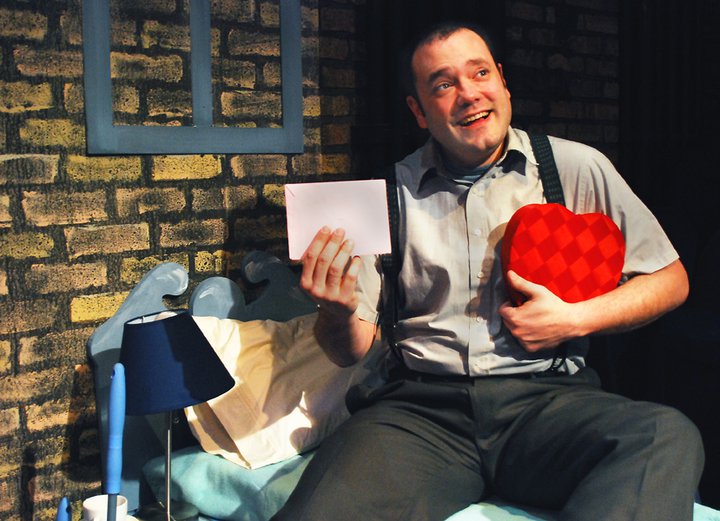
The set was very surprising. They said you can go have those seats right there, and I said "What? We're sitting on the stage?!" Sitting on the stage was kind of scary because the actors are really close. I liked sitting on the stage, too. Even if it was kind of scary I liked it. It was really fun how we got to sit on the stage. The actors were up on the stage and not up on the stage. They were in the other audience. It was more like a famous theater that was after Shakespeare but before us. If you don't know about Shakespeare you can learn it from me--ADA GREY! Shakespeare is a Elizabethan playwright that was really great and he wrote Romeo and Juliet, but he didn't write Somebody Loves You, Mr. Hatch. I thought the person who wrote Somebody Loves You, Mr. Hatch was not as good as Shakespeare, but she was really good. Her name was Frances Limoncelli. She just wrote the play based on the book, but she didn't write the book. Eileen Spinelli is the person who did the book. They were both really good.
There were only four actors in the play. And they all played different parts except for the person who played Mr. Hatch (Michael T. Downey). He only played one part because he had such a big part, and since he got the biggest part he didn't need to play another character. His performance I thought was really funny and sad. And mostly he was funny, not mostly he was sad, but sometimes he was a little melancholy. When he was happy I felt a little more happy, and when he was sad I felt a little more sad. I think the actor was kind of trying to make the audience feel the way the character felt, and I thought that was good. And it made me feel good that I was one of the people that was feeling good with him. Mr. Hatch's performance was great.
Sara Sevigny played Mrs. Weed, Co-worker #1 and Mr. and Mrs. Dunwoody. Mr. and Mrs, Dunwoody you didn't actually see all of their body; you could only see their head and arms because maybe Sara was dressed like her main character, Mrs. Weed, and they didn't want you to see that when she was playing Mr. Dunwoody because she was in a dress! Mr. and Mrs. Dunwoody were really funny because like the things they said like "What do you think Mrs, Dunwoody?" and she would come out in a bonnet. And I thought that was really funny. So funny. The co-workers were kind of nice to Mr. Hatch when they realized he wanted to give them a chocolate and then they realized that he was really nice. Mrs. Weed had a little dog named Ruffy. It was a puppet. She made the voice, and she had her hand inside. And it must have been animatronical marionette because it was like running when she was actually not moving. Mrs. Weed was pretty funny at some parts like when she made Ruffy chase the mailman. I've seen Sara before and she was in The League of Awesome. I thought she did a good job, and she had a good part, and she had to wear a funny dress in The League of Awesome.
Tuckie White was really fun, and she had to go on a see-saw that was almost too small for her. It was really small so it would look like a kid's see-saw. Her different parts were named Tina Finn, and she also played Melanie Todd, and she also played Ms. Smith. Melanie Todd was younger than Tina Finn. She did a good job playing different ages, and she did a good job pretending to sneeze because it sounded like she was actually sneezing. She did a great job doing everything she had to do in the play.
Micah J. L. Kronlokken, he played three different parts. He played Mr. Goober and that character was a mailman. And he also played Co-worker #2 and a person who sells meat, Mr. Todd. When he did his parts I thought he did a really good job because then when he heard what Mr. Hatch said ("I'll go pick up your daughter which is Melanie Todd") he seemed really surprised. And when he asked Mr. Hatch to give him the gift he sounded really sad and then he had an idea that he would make him happier. We said something that made him feel better because Mr. Goober told us to, and you usually have to listen to the actor if he says something.

The scene where Mr. Hatch gets the package he was sitting down, and then he heard the doorbell ring, and he looked at the doorbell and was like "Huh?" because he didn't know who it was and he didn't even know the sound of his doorbell because he didn't get any packages that much and people almost never came to visit him. Then it ding-donged it again, and he was like "What? Again?" And then he realized it was his doorbell. So funny.
People that would like this play are people that like books, funny things, sad things, and Valentine's Day. I recommend that people see it a few times because I loved it. I think this play should be for ages three and up because it doesn't have any scary parts. It does have some sad parts, but I think it would be ok for three year olds because it is very happy at the end. It tells you about people--that just because they are stubborn it doesn't mean they are bad. When you do good things to people if they have treated you badly they will start to do nice things to you like give you presents, and get you tickets for shows, and get you ice cream. The end.
Photos: Suzanne Plunkett