Cyrano's nose was the biggest nose after Pinocchio--which has a very long nose, so that means Cyrano has a very long nose, which you will see in the picture below. I wondered how they made his nose grow so long. I think it was a rubber nose that they glued onto his face. I thought it was kind of weird that people that saw his nose were like "Oh my gosh!" because his nose wasn't sooo weird. In this letter Roxanne says "Even if your handsomeness goes away, I would still love you." She thinks she is writing to Christian but she is actually writing to Cyrano. That means that she doesn't really care if somebody's nose is long. She'll love them anyway. I think that is good that she doesn't care how handsome they are, just how smart they are.
I liked the songs (by Kevin O'Donnell, Shawn Pfautsch, and Matt Hawkins) but my favorite one was "Panache." "Panache is a word that makes me crash"--isn't that a good rhyme? Panache means white feather in French. I found that out on Wikipedia. The feather makes him look like a poet. It is like everything in the whole world to him. It's a very special feather that makes him who he is. Panache is poetry-ness. Poetry-ness means that he writes good words and he is good with romance and stuff like that. He fights funny, and he fights in hard ways--how can you write a letter while you're fighting? That is particularly what I mean by panache.
The first scene where Valvert (Jason Peregoy) was fighting Cyrano--that was the "dink scene," as I call it. I call it the "dink scene" because one of the most funny lines was "dink." So Cyrano was fighting with Valvert, and he is composing a poem, and then--suddenly--Cyrano very quietly, the slightest bit of stabbing, he stabs him and "dink." He stabbed him and the "dink" was like he had just made a tiny little dent in him. Ligniere (Mike Smith) barges in and says "That was awesome!" and he just keeps trying to imitate Cyrano. He kept going "ching, ching, dink!" twice--and it was so funny.
The ninja scene is where Cyrano is fighting ninjas that just barge in suddenly. In the play he is supposed to be fighting off one hundred people, but he actually isn't. They give you a very good feeling that you are actually seeing one hundred people being fought. It is a mystery to me how they made it seem like there were one hundred people; there were only twelve people (Justin Verstraete, Meredith Lyons, Jon Beal, Marty Dubin, Megan Schemmel, Jennifer Betancourt, Jack Miggins, Aaron Kirby, Glenn Stanton, Shane Brady, Mike Smith, and Jason Peregoy). He fought each person like ten times. I liked the ninja scene a lot--that was my favorite scene. They've all surrounded him, and then Cyrano says, "Well you want to play this way, do you?" He gets every single sword that surrounds him like a xylophone. And he just hit all the swords in one slice. I thought that was amazingly cool.
This is one of my favorite scenes because it is hilarious. In this scene Christian is talking to Roxanne, and he did a very very very bad job because he doesn't have very much poetry like I said in the first paragraph. She said, "So tell me what you have to say," and he said, "I love you." And then she said, "Tell me more," and then he said, "I love you." "Tell me more than that." Then he said, "I love you so much." And then she said, "Get more into it." And then he said: "I will unfold my lips onto your mouth." And that did not go well. When he tried to kiss her she fell off the piano, which they happened to be sitting on. And that had to hurt.
In the balcony scene, Christian comes and Cyrano is trying to tell him what to say to Roxanne. And Cyrano says, "Say her name." And then Christian says "What?" Then Cyrano says, "Say her name!" and then Christian says, "Her name. Yeah." Then Cyrano says, "Roxanne!" Then Christian says "ROXANNE!" And then Roxanne is like "What?!" and she looks down. And then Cyrano comes and says, "We better switch." And then he says very poetic things. And then he says, "There is one last thing I would like to have of you." And then Christian says "a kiss!" Then Cyrano says, "Shut up, Christian" through pursed lips. Cyrano says, "I was contradicting myself for going too far." I thought this scene was really funny because Christian is really bad at poetry, but he is trying to say what Cyrano is telling him, but he can't actually do it. This scene is kind of scary because you think Roxanne is going to be angry at Cyrano if she finds out that he is at the bottom. You feel bad for Cyrano because he loved Roxanne and he plays a sad song and Christian gets to go up and kiss her.
There was this funny scene where the Spanish came in and he said "Parlez-vous Francais?" and they just kept standing there with the swords pointed at him. Then he said, "Parlez-vous Espanol?" And then they like nodded their heads and he keeps writing and he says, "Oh crap. Ahhhhhhh!" because he is trying to kill them because they are against the Spanish in that time. He keeps trying to write the letter while they are fighting. But writing the letter works out very badly while he is fighting because someone is too excited about fighting than writing a letter about love.
Finally Christian decides to let Cyrano marry Roxanne because in a letter she said that she would love him even if he was amazingly ugly. That means she would adore Cyrano. Because Christian dies, Cyrano can't tell Roxanne that he is actually the person she's in love with because Christian is dead and she is really sad. Either way, they don't get to get married because...you will find out in two paragraphs. Christian dies because the Spanish kill him not knowing he is in love with somebody. I thought it was a cool battle until Christian died. Then I hated it because I loved that character. He was hilarious.
When Roxanne heard about Christian's death--that was a sad scene. She went down and cried. And remember when Cyrano kept making her hit the keys on the piano. He was making her feel better. She was very beautiful and smart and lovely and had good taste. She should have chosen Cyrano because he was the only person that she actually liked a lot that was still alive.
In the last scene, Cyrano comes to visit Roxanne with a broken head. He has a big, long, very cool speech, and then he dies. And his last words are, "there's one thing that I will take up to the moon with me...my panache." When it happened I was very touched. I think she actually loves him in the end, but he never actually gets to marry her like he wants to. Everybody in the audience was touched except if the Joker was there. Then he would not be touched, because he is a supervillain. Catwoman and Poison Ivy would because they are more gentle-hearted than others.
Cyrano is for ages 6 and up. The things that might parents have to think twice about are the big kissing scene, the word "shut up," the bloody head, the dying, and the fighting. The things that I think the kids would love are the balcony scene, the song "Panache," and when you first meet Christian. I don't think other kids would be as comfortable with the fighting because I have seen lots of plays with fighting in it. People that would like this show are people who like romantic stuff, poets, duelling, funny stuff, and long noses. You can get poetry-ness if you go to see this play--if you don't already have it. And you can get more if you already have panache.

Pinocchio is about a puppet that comes to life and becomes a son to an old man. Pinocchio's nose kept getting longer because he keeps lying. The play feels like lying is a bad thing. I think it is sometimes a good thing and sometimes a bad thing. If a villain was asking for your money you could say you were poor and didn't have any. When the Cat and Fox are telling Pinocchio to bury the money he could say I am very rich and don't need any more money. That would be a lie, but then they wouldn't steal money from him. When something bad is happening, then you can lie because you need to save yourself.
I liked the scene where Pinocchio (Skyler Adams) was in the puppet show. The puppet show was done by this terrible person who killed puppets; he was called the Puppet Master, played by Ron Rains. Pinocchio danced better than Mary and Annette to show how cheesy the other puppets were. They just like moved their arms floppy and they didn't look real. They sang like robots, and they looked like robots. The actors (Hannah Sielatycki and Katie Spelman) did a good job pretending to be marionettes. The joke was Mary and Annette made the word Marionette. Mari Onette. I thought that when Pinocchio dances he dances so much like a human that they thought he wasn't a puppet--but actually he was a really good dancing puppet. He did a really good job too.
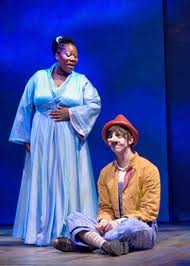
I think Melody Betts in the program should not be the Storyteller but should be the Storyteller/Blue Fairy/Geppetto's Wife. That would be more specific of who she played. All three of those parts were the same person. You didn't know she was Gepetto's wife until the end, but you did know the Storyteller and the Blue Fairy were the same person. I like how she was Geppetto's wife; I thought it was touching and unexpected, and I thought she looked like a very nice Fairy and Mother and Storyteller.
Lampwick is really mean and ornery. Lampwick was played by Dylan Saunders. He sang this song with Pinocchio and the other boys saying, "Terra DI Ragazzi!" I really liked the song called "Terra DI Ragazzi" because I thought it was a cool and catchy song. I wanted to sing "Terra DI Ragazzi" a thousand times in a row. It is about Terra DI Ragazzi which is a fun park with no girls (no fair!) and no parents and no teachers. One reason that I want girls to go to Terra DI Ragazzi was I want more girls to be in this play. And, two, why I don't want them to go to Terra DI Ragazzi (do you like how I say "Terra DI Ragazzi"?) is because they are going to turn to donkeys.
Liz Pazik played the Driver who sang the song with the boys and Pinocchio. She was trying to get them to come to Terra DI Ragazzi. I thought The Driver...it was kind of weird because she said no girls but she was a girl herself. Maybe she auditioned for the part and did a really good job even though she wasn't a boy. And you can't judge by sex.
The scene in the whale was hilarious because Pinocchio said, " I have donkey ears, I have a tail, and I'm in a fish." I thought it was funny because it was getting worse, it was getting worse, and it was getting a tiny bit better. Being in a fish isn't as bad as being half animal because he might be able to get out of the fish.
I liked Don Forston in The Emperor's New Clothes. He played the Emperor in The Emperor's New Clothes. He was really funny; he reminded me of one of my teachers named Mr. Jay. The problem with Geppetto is that Geppetto is a very stupid character. He sends his child away when he is not even a day old. Maybe in that time they didn't have homeschool and it was the only way to get an education. And everybody wants an education. You have to be more than less than one day to start school. He should have waited and not sent him off on his own when he was only a few seconds old! Geppetto learns his lesson at the end. His lesson is 1) don't send your child out when he is less than a day old, and 2) he shouldn't send Pinocchio to school when he only knows a few words and how to sing. Pinocchio should also know how to say the ABCs and stuff like that. Geppetto should have taken Pinocchio with him to get the ABC book. Then Pinocchio could have picked out the ABC book he wanted. Like there could have been one that was white and Dr. Seuss.
Ericka Mac played the Cat. The Fox was played by Derek Hasenstab. I thought they were funny in their parts. There was this funny part where the Cat said "Don't dig up any wooden nickels." And the Fox said quietly, "Wooden nickels. That's hilarious." The way they said their lines was cool because they said that money actually grew on trees, but it didn't. It actually got stolen. They stole it! In the Disney Pinocchio they made the Fox and the Cat kind of creepy, but in this they made them more lovable.
Kevin Depinet was the set designer. I thought it was a cool set. The wheels at the top of the stage turned on with lights and colors and became ferris wheels. And I thought how they did the whale was cool. They made part of the stage open which was the mouth, and then they made it close, and they made red lights for the eyes. Meredith Miller I thought did a good job doing the puppets. I thought it was cool how they used the puppets to tell parts of the story. I thought it was interesting because they go back and forth: so one time Pinocchio is played by a puppet, one time by a human, one time by a puppet.
The people who will like this show are people who like puppets, fairy tales, Italian people, and fast, catchy music. I think this should be for ages two and up. If a two-year-old wants to come and see this, there is one thing they might be frightened of, so beware. It is the whale with the red eyes opening and the mouth. I think Chicago Shakespeare is not only good for Shakespeare; it is also good for children's shows.
Photos: Michael Brosilow

I really liked going to the play Macbeth. It was the first time I've seen it live. It was really fun because even though the witches were the scariest things in the world, I got to talk to the witches and I knew them all. One of them had really long claws; one of them cut off somebody's leg; and one of them was the leader of the witches and she cut off a pilot's thumb. They were played by Sara Gorsky, Danny Taylor, and Lily Mojekwu. In the play they are supposed to have blood running from their mouths when they ate Banquo's soul. I went to this rehearsal because it was a not-blood day.
Matt Kahler played Banquo. Banquo was friends with Macbeth but Macbeth didn't like him after all because he asked somebody to kill him. When he was a ghost he was good at being a ghost because his eyes were half-open and half-shut. When they ate his soul he woke up, and I think he was supposed to be really bloody in the show because they had to tear apart some of his body to get to the soul. Macbeth (John Mossman) said to Banquo "Don't shake your bloody locks at me."
Banquo's son Fleance was played by Brittany Burch. I thought she did a good job dying playing Young Seward. She also played Lady Macduff who was one of my favorite characters. I like dramatic characters. When her son died that was really dramatic. In the scene where Lady MacDuff's son died they took the baby and the children off stage to be killed because the son was played by a girl who was actually a grown-up, Sara Gorsky. Then it would be scary to see real children and a baby be killed. But they are not actually killed--but it would be horrifying to see your child play a character who got killed by two murderers.
I like death scenes, so I liked when Duncan dies. It's alliterative: Duncan dies! You have to imagine that Duncan (Noah Simon) is laying in a beautiful chamber with his two helpers; they kill Duncan offstage. So you have to imagine that Macbeth comes with a dagger, stabs Duncan with a dagger, comes out with two bloody daggers. This is what you can see: Lady Macbeth (Elizabeth Laidlaw) tells him to go back in and put the dagger on Duncan's chest, smear blood on Duncan's face so it looks like the helpers killed him. Then Monsieur Noah the Porter was played by Noah. And he is letting in spirits, and I was a spirit: I was an English tailor. It is kind of weird that Noah was dead like for a second and then one second later he was telling a joke. He was letting in a farmer that killed himself and a tailor that stole from his boss (me). It was funny because he is letting in dead people that actually he shouldn't be letting in. He shouldn't let them in because one of them could commit suicide in front of him and the other one could steal from him.
The final battle: Young Seward dies in that and he is on the good side. And also Macbeth dies. And he's on the bad side. He thinks he cannot be killed because the witches had played a trick on him which is no one can kill him except someone who is born by a c-section. He thinks nobody can kill him. When the people dressed up like trees and bushes of woods, then he thought that the woods were coming closer and that was one of the witches' prophecies that he would die. And when they were coming closer, he hadn't realized that he could be killed by somebody that had been born by c-section. He finds out that he can be killed by Macduff (Jeff Christian) when he gets killed by Macduff. I think you are curious about if Macbeth is ever going to die and then bam! he's dead. I liked the scene where Macbeth dies. I think there was very good fight choreography because it actually felt like you were in a room where somebody was going to be killed in about five seconds.
Lady Macbeth was in the last scene of the play even though she died. She looked so creepy, and she looked so much like a zombie. I thought that was kind of cool. It was like she married one of the witches. In the first scene that you see Lady Macbeth, she looks sweet and kind, but in the next scene when she is trying to get Macbeth to kill the king she was really pushy and mean and evil. I think she was going to have a baby once but it didn't work out. Macbeth just wants to stay like a Duke, but Lady Macbeth wants to be more royal. Macbeth is a kind and honorable man, but then he turns evil and terrible and wants more power. They each want more power because of who they are married to. She wants more power because of her husband, and he wants more power because of his wife. The moral of this story is "don't marry somebody who wants more power."
I think Macbeth is a great play. In the exact first scene with the witches I thought aaah! it is really happening, but then I was like, even though people are being murdered, I know it is just a play. I think you should see a play of Macbeth because it is now one of my favorite Shakespeare plays.
A Midsummer Night's Dream used to be one of my favorite plays because it was funny and it had fairies in it. It is still one of my favorite plays, but not my favorite favorite of all favorites because now I am older and like plays with murders and stuff that is scary. I am not as big a fan of comedy as I am now of drama.
The lovers were Helena, Hermia, Lysander, and Demetrius. They were played by Sara Gorsky, Brittany Burch, Shane Kenyon, and Josh Zagoren. I think Demetrius wants to marry Hermia because she's rich. Hermia, she wants to marry Lysander. It is a love triangle. It actually does make a triangle! (See photo: it means love triangle but with superheroes.)If there are two girls that love one boy or two boys that love one girl that is a love triangle. And there can also be a gay love triangle: boy boy boy or girl girl girl. Or boy girl boy or girl boy girl. When Helena shows up, then the two boys fall in love with a different girl. It is still a love triangle, but with a completely different girl. The funny part was when the two boys, Lysander and Demetrius, were exercising in front of Helena because they were exercising while she was fighting with Hermia. Maybe they thought it would impress her if one of them was stronger or musclier. But people aren't going for muscliest; they are going for smartest. It isn't a love triangle at the end. They each get a girl, but one of them used to not love the other one. Puck was freezing them when they were kissing, and it was a long time that they had to be kissing. They couldn't move. I found that weird. When they were paused, Puck did it and the fairies walked through and they talked and stuff and then it was over.
The fairies were Titania, Oberon, Puck, and the first fairy. Titania was played by Lily Mojekwu. Oberon was played by Matt Kahler. Puck was played by Danny Taylor. The first fairy was played by Elizabeth Dowling. I loved the first fairy--I think for someone for Puck to be in love with--that is a good add. In the last scene Titania and Oberon have fallen back in love, but I think she shouldn't marry Oberon because I think he is a mean fairy because he wants to steal from his wife. I wish that there were more about the changeling boy--like you could see him. I just think if she cared about him so much, she would be with him the whole time. The people in the show couldn't handle a changeling boy because the baby might have cried backstage. And then the baby in Macbeth--which was just a big blanket--wouldn't seem real. Puck was kind of the main fairy in this, and I really liked this actor--even though he was creepy in Macbeth. His performance was good because Puck when he went to go get the flower he actually did it in two minutes instead of 40 minutes. It actually only took 2 minutes to fly around the earth. And that is a world record. Go, Puck! Go, Puck!
There are these people that are in a play and then they put on a terrible play which is hilarious. It is so funny. These people are Snout the tinker (Elizabeth Dowling), Flute the bellows mender (John Mossman: oh my gosh he played Macbeth and Theseus. Oh my gosh. Someone was in a play at their own wedding! Flute was so terrible at Thisby and then the person who played Flute played Macbeth, and he was double amazing!), Bottom the weaver (Noah Simon), Snug the joiner (Jeff Christian), Starveling the tailor (Elizabeth Laidlaw), and the director's name is Petra Quince (Christy Arington). They call her Petra instead of Peter because she is a girl and she's playing a girl character that in another version of the play is a boy. They are not actors. They just got hired to be in a play. And that is why they are so bad! They are not actually actors! When Flute and Bottom kissed they went "eeew" after, so it didn't really seem real.
There's another love triangle! Snout the tinker and the director were both in love with Bottom. I don't know why. Bottom the character is supposed to be kind of weird and he is very bad at his job as an actor. And he turned into a monster. But Noah, the actor, is not at all like that. He is amazing at his job as an actor. Titania falls in love with Bottom because of a flower. And it was a love circle, then, because Titania was also in love with Oberon and there are three girls that like one boy, Bottom.
I would recommend Macbeth for ages 10 and up, but I am a very brave 7 year old. I would recommend A Midsummer Night's Dream for ages 3 and up. Lakeside Shakespeare is a very good company because it is really fun if you are going to a picnic and somebody else wants to go to a play, you can go to a picnic play. People that like Shakespeare, murder, comedy, and fairies and witches would like these plays.
As I am an honest Ada,
Give me your eyes if we be friends
And Ada will review again.

Dixie Uffelman played Kim. I liked Kim's character because she is a good person to have in something like this. She is an orphan. She used to like people, but she didn't like people when her parents "went away." When I said "went away" I meant die. The people in the Care Bears reading put it in quotation marks because they didn't actually go away; they actually died. In the movie they just said went away because they didn't want kids to be sad about parents dying because that is something that you need to think about later in life. Kim, I think, is Mrs. Cherrywood. I think it is because at the end she says "That is my favorite story." And then Mr. Cherrywood said, "It made me happier that I ever could be", so that sounds like she knows the story because 1) she just heard it lots and lots of times or 2) she was a characterin the story.
Joey Steakley played Good Luck Bear. Good Luck Bear was Irish, and he was so funny. He was sooo Irish. He had the Irish-est accent in the world. It was tooo Irish. He said his name "Goood Luke Bear." And he also said Lollipoop, and all the words were all vowels. It was so funny. Can you imagine that? Joey also played Mr. Cherrywood who was a Canadian kind of father. And Mr. Cherrywood is also Nicholas. Nicholas is the villain of this story, but it turns out that he starts to care. He is a villain because he likes this book--an evil spirit. Not like "like like" but like "like." Hear that? An eeeevil spirit. He becomes friends with Kim and Jason; that shows that he starts to care. He always flapped with his cape whenever the narrator said "Nicholas." Birthday Bear is a really funny Care Bear because once when someone brought bad news, he said "Something terrible is happening" and then he said, "Happy Birthday!"When he always said happy birthday that was not in the movies. I think it was Joey's idea to be funny.
Shawn Pfautsch played Mr. Fettucine. He was really funny because one time he changed characters at the wrong time. One time he thought he was supposed to play Mr. Fettucine but he was actually going to play Tender Heart. He put up the mustache, and then he looked at the script and just pulled up his hood again that meant that he was a Care Bear. Tender Heart was one of the main Care Bears. He went to go save Nicholas. So did all the other care bears, but he was the first to discover Nicholas and the book. Once he was like "Nicholas, NO!" and then Nicholas was like "Aaaaaaaaaaaaaaaaah!!" It was so funny because Nicholas was so loud it sounded like he was being murdered.
The evil spirit was the actual really terribly bad guy. Marika Mashburn played the evil spirit. There was this part where the narrator started talking and then the evil spirit laughed in the middle of his sentence. That was so funny. I don't think she was trying to be very scary--because they are making fun of the movie. And she also played the penguin. The penguin rescues Sleepytime Bear. In the movie she actually just threw him back in the lake instead of putting him back on the ship. The penguin was like "hi" and then walked back up to the ship without taking him actually on the ship. Sometimes the spirit was creepy. I also loved when Nicholas was trying to close the book and then she said, "don't close me" like she was actually being closed.
Brandon Ruiter played Grumpy Bear and Jason. And Jason was a little boy who didn't want to make friends. He is the brother of Kim which I talked about at the beginning. Grumpy Bear was funny and he worked with Good Luck Bear. They are trying to make the Care-o-Meter work again. There was this really funny part where everybody said "The Care-o-Meter has dropped to zero!!" And then Grumpy Bear says "Ca-ROM-eter." They call it the Care-o-Meter because they are Care Bears. In the movie, they said Care-o-Meter only. They didn't say anything else. I think that in the reading they decided to do it the other way because they thought it was funnier for a Care Bear to correct them because he's grumpy.
Ben Lobpries, he played Friend Bear and Lotsaheart. Lotsaheart was a Elephant, so when he said "well it has to go somewhere" to one of the Care Bears when they were on a ship, that is kind of weird and stupid, but in a funny way because most people would already know that it has to go somewhere if they had a brain. Everybody knows a ship has to go somewhere. Friend Bear was on an adventure with Secret Bear and they are trying to send Kim and Jason back to earth but they can't. The caring forest is another place about caring--like Care-a-lot. And there was this funny part where Friend Bear said, "My Bed is fluffy as a cloud," and Kim says "Your bed is a cloud." And then he says. "Ha. Ha. That's right." They both had it in the movie and the reading, but I liked it best in the reading because it was funnier because Kim in the movie said it very plain and not very funny. Kim in the reading said it with a different style--I would call it like a "duh" style.
Ele Matelan played Secret Bear. There was this really funny part where Sceret Bear was whispering to Friend Bear. Then he said, "Secret Bear says not to worry about the falling. Worry about the lion instead." And then he's like, "Lion? Lion!!!" There was this really funny part where Secret Bear gave birth to a key. So the key got stolen, and the she kind of gave birth to another key, like getting it out of her tummy. It was gross.
The narrator (Johnny Arena) was not actually a character in the story. He doesn't even tell the story--Mr. Cherrywood tells the story. The narrator just says what's going on, like "Meanwhile..." and stuff. He kind of made the story a story because if they were moving on to another part of the story then if he wasn't in, nobody could have said "Meanwhile..." so you wouldn't know there was a switch. I knew where we were going in the movie because you can actually see in the movie, but this was just a reading. I loved how the narrator kept saying the word Canadian: "A houseful of Canadian orphans" and "Two very happy Canadian children were sitting between their two happy Canadian parents." Canadian Canadian, Canadian.
It is possible to like the movie more than the reading IF you are a big Care Bears fan. Finding out that the reading is funnier would make Care Bears fans feelings about the Care Bear Movie different but in a good way. It would show them that the Care Bears Movie is terrible and this reading is awesome. I would recommend the people that read my reviews see the movie if they just think of the reading in their head while they are watching it.
I think you should see readings and plays by the House Theatre because they are a really awesome company. And the Neofuturists is a really nice theater. I have never seen anything that is bad at the Neofuturists. Not a single thing.

"It Came from the Third Dimension" was really funny and cool because at the beginning they were just flat puppets, so they were in the second dimension. So they went into the third dimension, and the people who were working the puppets became the puppets kind of, only that they were third dimensional like me, the universe, everybody. And when they turned into the people, they were like "What? What? Who?" And then they were like, "We've done it! Into the third dimension!" Then they would touch people because they were like, "this is so beautiful and cool. So much mass, so much volume." I felt like I was in two shows when I got touched by the actors in the third dimension. It was cool. When they were touching people, it was so funny and crazy; it was awesome.
When the scientists were looking at the people in the audience, then these birds flew in, and they tried to catch the birds, and they were talking about samples. And they were so funny because it looked like all they cared about was the samples. They were like "samples! samples!" It was really hilarious. Then one of the scientists ran in, and his friend had been eaten by a monster. And he was like, "What have you done with my friend, you third-dimensional nightmare?" And then the monster looks at him, and the scientist is like "who--o-o-a." And then the scientist is like, "I know. I will defeat you with the power of science." The power of science was weird and stupid in a funny way because he just threw the bird at him--so that was the power of science in the play. But that was not really the power of science in real life. That was really weird. The power of science in real life is racing to see who can complete a science experiment fast.
When the monster came out I was kind of creeped out because I didn't know it was going to happen. But then when the monster started doing things, and the scientist was there, it was kind of funny because the scientist was doing all these funny but very stupid things. The monster was like a big puppet that lots of people had to get into. It had no mouth; all it had was wings and eyeballs.
This was one of the very funny plays because of all the funny lines, the monster, and the acting. And almost all the time it was funny, except if it was your first time (or only time) seeing the monster. Then it was kind of scary.
There was this fun show that I didn't see all of because it had a really weird ending that children could not see. And the play was called "Confluence." It is about this mass on this man's thigh that cannot be touched. If it is touched, he dies. The girl is in love with him, but they can't do things they want to because of the mass in his thigh.
There was this really funny part where a girl named Joy had toilet paper in her shoe. That was how they fell in love. They were seeing who could pick it up, and then the boy picked it up, and then this music came on, and then he handed her the toilet paper. She was like "thanks," and he was like "oh, that's gross," and he put it in the pocket that didn't have a big bulge. She said "it went on like this for the rest of the night"--that is a very funny line because them staring at each other because of toilet paper is just weird and it could never go on for all night because they would have to yawn once.
"Confluence" was really fun because it was really funny. And even though it was the grown-upist show in the whole Sketchbook, it was kind of for kids because of the toilet paper and how they fell in love about toilet paper and also the frog story. The frog story was about a frog and about how Nathan was going to smash a frog but he missed. It is just a weird story. That is like a funny kid's thing.
"The Franchise" was a really funny piece. It was about this firefighter that really liked being a firefighter, but his wife didn't want him to get hurt. He kept talking about putting out fires with his blood. That was funny but kind of grody. And it was really weird because putting out fires with blood never happens because the only way to put out a fire is not with your own blood but with water, wa-ter, w a t e r, water! That character is crazy.
There are these hilarious places that they went where they put out fires. The first one was just a plain old fire. I liked the DJ one, and I also really liked the one where all the people come in that he worked with but John the firefighter wouldn't listen to them because he was so in love with his wife. He has to go put out a fire...in space! It was very weird. And there was this really funny part when they are discussing about what they should do, and he asks "why can't I put out a fire!?" and his wife says, "because it is metaphorical." If you don't know what a metaphor is, you can learn it from me, ADA GREY! (and MY MOM! because she told me what a metaphor is. I learned it just a few seconds ago.) A metaphor is like (here is an example that I came up with) in "The Parasite," which I am going to talk about next, she says "I am on fire." She feels like she is on fire because she is so in love with a parasite, but she is not actually on fire.
There was this funny part where this guy was holding a gun up at the firefighter, and then he was talking, and he said, "Pip pip cheerio, Mr. Blaze. Pip pip cheerio forever."And then he did a little bow; it was funny. And then he laughed an evil laugh, and then they just started going down like in an elevator. They just went down like on to their knees, and then you couldn't see them. This show was really funny.
"The Parasite" was a very fun play even though there were a few swear words. The play is about this woman who is in love with her parasite. If you don't know what a parasite is, you can learn it from me, ADA GREY! A parasite is a kind of bug that lives in your body. And in this play, somebody says "It's eating you!" There was this really funny part where her friend doesn't want the parasite to be with her, and they are arguing about him. Then the girl that is in love with the parasite says, "He's different. He's...he's...he's...Spanish." It is funny, because it doesn't matter where he is from. She means that she's really in love with the parasite because he's handsome and sings. She loves Spanish songs so then she is like "ooooh" when he sings.
There was this really funny part where he said, "I weell sing you a sowng," and a guitar was on his back, and then he turned it over and he started playing it. And here is the song he sang, "Mi Aaaaa-morrrr!" And then she just sat on the table and cleared off all the nail polish with her hands and it made a big clank. Then she put her glasses into her pocket because she wanted to look beautifuller and so she could kiss him better.
The parasite gets strangled by her friend, and then the girl that is in love with the parasite is really sad. The first time I saw it, I thought it was kind of tragic. But then when I saw it the rest of the times, then I thought it was kind of funny because he looked like a bug, so much like a bug, when he died. He had his arms up like with his fingers all bended and his elbows pushed in.
It was a really funny show because the actors were really good actors and they just were too hilarious--but in a good way too hilarious.
"I Wish You Love" was a kind of dance. There was this ship--a girl with a ship hat, actually--and there was also this man who smoked a cigarette who looked like a lighthouse and looked like he had rock hair. I don't mean like rock-and-roll hair. I mean like rocks.
I wish I could do this part of the review with icons because this one should be with icons because nobody actually had lines. I would use the icons which would be ship, lighthouse, water, an icon that is a bit to the side to show her head tilting, rocks, and coming toward somebody, and break, and smoke a cigarette. And last--but not least--laugh because everybody laughed at this one.
It is sad because the ship was so in love with the lighthouse, but when she broke herself on his rocks he didn't care. I think it is called "I Wish You Love," because it was just kind of short for "I wish you loved me." I think it is just like a sniffle sad. The ending was funny because they showed it in a funny way, which was it made the ship look like it was actually being wrecked because her head tilted. It can be both hilariously funny and sad because it was just a boat and a lighthouse--not people.
"Evolution" was about Kristoffer Diaz writing this play that I'm going to talk about. It is kind of weird to write a play about the play that he's writing. I think the two grown-upist plays in Sketchbook were this and "Confluence." It was about critics (like myself) not liking other people's plays. The critics should just go with what they want to say but not just say "this play was terrible. I hated it." They should say some bad things and some good things. Then the writers and the actors know that you thought it was ok, but just not the best play that you ever saw.
It starts with Kristoffer Diaz played by an actor bringing an actual person from the audience onto the stage and onto the couch. There was a choice that that person had to make, a decision at the end. Here are the three options that he gave: 1) tell him that he's wrong, 2) kiss him, 3) punch the critic in the face. Nobody said he was wrong. One kissed him. Mostly they asked Kristoffer Diaz to punch the critic in the face. I think I would choose to punch the critic in the face. I just don't think he is a very good critic. Nobody thinks I am a bad critic, so it wouldn't be like punching myself in the face.
[Hello. This is Ada's mom. Ethical reviewer that she is, Ada has asked me to review the piece in Sketchbook in which she appeared so that she would not have to review it herself. Here goes. "I and My iPhone" featured the Red Orchid Youth Ensemble and was a treat for me to watch each of the ten times I saw it. Like many parents, I tend to watch my own kid the entire time she is onstage. When she did The Nutcracker at her ballet school last year, I was convinced the whole ballet was about a child party guest who gets a gift from the Stahlbaum family, watches some dancing dolls, and then falls asleep and is carried home. Frankly, the second act seemed to go off the rails; what do dancing flowers have to do with a child party guest? So, it is a testament to the great actors in "I and My iPhone" that I know what each of them looks like and realized that the play was about a teenager whose family and friends stage an intervention to confront her about her iPhone addiction. These kids were funny, articulate, and authentic onstage--when they were throwing that iPhone around, I felt real anxiety for its safety. Just as important to me, as a mom, the whole cast was sweeter than pie to my kid offstage. The ensemble gets a rave review from me for that too.]
I think Sketchbook is a really fun thing. It is really fun because when at the end of a play you are like, "Aww, it's over" then in Sketchbook you are like, "Yay! There's another one!" Sketchbook is a cool, crazy good time. Next year, I think Sketchbook is going to be still one of the awesomest things to see.
Photo: Candice Conner
 Once upon a time I went to a play and it was called Cherry Orchard. And I think there were some problems with the direct address and the script was not the best adaptation in the world. Not all versions of Cherry Orchard are like this one; some are awesome. There was direct address---too much! They used some lines that were directed to characters in another Cherry Orchard that I saw, but in this one they were directed to the audience. Then it is not exactly a play; it is just a person talking to you in a costume. When characters are talking to each other, then it is more of a story. Direct address is good when the audience is a character. Like in Liza Minelli's Daughter, we became a character in the story. We danced, and she told us stories, and she climbed up into the audience and talked to us. When I went to go see The Cherry Orchard, it was not the best play in the world, but I still liked some of it.
I liked the dancing scene. It was a cool scene because there was dancing that was folk dancing. They did Russian dancing because it took place in Russia. I think that they put the scene in because the director thought it would be a good scene because he put funny things in it--like when Yepikhodov (Fernando S. Albiar) fell down trying to do the Russian dance.
I liked the scene where Charlotta (Liz Fletcher) was cleaning a gun. It was really funny. She said she didn't know who she was, and when she leaves she says, "I still do not know who I am." She should know who she is, and she didn't even know what her name is. All the audience knows exactly what her name is. Why don't we just get her a dictionary? She had a dog which was not an actual dog, and you could plainly see that. It was funny that you could plainly see that it was not an actual dog. The trick with the baby was really funny because she like tricked people that it was an actual baby. If she knows magic tricks, then it makes her character more interesting. I liked her because she was funny.
And I also really liked the scene where they move back into their old house after being in Paris. It was a nice beginning. When they got there you heard this "Hooray!" and this smooching. It was kind of weird, but it showed that they had not seen each other for a long time and they really liked each other.
I liked Varya (Helen Young). I thought she was stern, and I like stern people. She was fierce, and I like fierce people.
I think people that like direct address, different kinds of translations, and silly stuff would like this play. I think it was an okay play, and I think this play should be for ages 4 and up. I think if they used less direct address, it would be a little bit better. And if they didn't take out so many lines, then it would show you what the actual play was really like. I think Chekhov would like it to be more romantic, and have characters actually go into the cherry orchard and not just have it in the background, and have people talk with characters instead of the audience.
Photo: Dean LaPrairie

Hazel was a very smart and helpful rabbit, and he was played by Paul S. Holmquist. He was always trying to keep his little brother safe. I don't mean like younger brother, I mean like runt brother. I really liked his part because he was kind. You think he was dead, but then he is actually okay. He starts out just being Hazel, and at the end he turns into Hazelrah which means King Hazel or leader Hazel. Paul Holmquist also played El-ahrairah. El-ahrairah is a legendary rabbit. There are lots of stories about him. Paul played both the parts because they both were almost the same: they were both rabbits; they both wanted to save their friends.
Chelsea Paice played Clover. Clover was very nice, and she was always trying to keep people safe--like when she was trying to get her friends to go live with Hazel with her. And she was the one that didn't get put in the cage. She also played Vinca who got killed at the very beginning. I don't think that was the owl getting Vinca. The black rabbit was the rabbit of death. The black rabbit takes her to the owl, and the owl gets her, and the black rabbit takes her away and turns her into a ghost. Vinca wanted to go anywhere her brother Blackberry was going. And then she dies. Then she didn't go anywhere her brother was going because she was dead. I was very sad for her.
Christopher M. Walsh played Bigwig. He was in love with Hyzenthlay, and he was told to watch over her while the others were gone because she was a troublemaker for them but not for Bigwig. Bigwig was fuh-larious. When he was trying to to sound disappointed he actually sounded very funny. When Hyzenthlay said "Don't forget to say that you were disappointed" he actually was disappointed, so it was very easy to say that he was disappointed because he was. He was disappointed that he couldn't make babies with her because it wasn't her mating time yet. He also was part of the Owsla in the first warren. He runs away with Hazel.
Mandy Walsh played Hyzenthlay. And she was in love with Bigwig. She wanted to run away so she could have babies. She had so many babies to take care of when she ran away. All the young ones were hidden and luckily none of the young ones died during the fights.
Scott T. Barsotti, he played Fiver. He can smell danger, and he's a runt. Hazel is his brother. He is scary at some parts. There was a scary part when he screams because Hazel they think is dead. He could smell danger at the warren, that something dangerous was going to happen. And he was right. Some believed him and some of them didn't.
Silver was played by Bryson Engelen. Silver was the cousin of Threarah. Threarah is the leader of the first warren. He was part of the Owsla for a month. Silver wore really funny goggles that I think were swimming goggles. I think the funniest person in how he moved around was Silver. He moved more like a rabbit than the others but none of them really dressed like a rabbit. Silver brings up the idea of rabbits fighting cats. I think he is obsessed with rabbits defeating cats. He thinks rabbits would give him a reward and make him a leader if he fighted a cat. I actually think some Rabbits could fight cats--like Hazel and Silver. They do once.
Dave Skvarla played Cowslip and General Woundwort. General Woundwort had a very creepy costume. He had like this scratch over one eye that showed that he always fights things. He wanted everybody to stay where he lived, and he wanted Bigwig to be killed. He's one hundred percent horrible. Cowslip was less scary, and he was nicer. It was awesome when Dave Skvarla played both the parts because then he got to play a good character and a bad character. Sometimes my dad gets to do that, so I thought it was cool. It tells you that they are actors that have spunk. Paul S. Holmquist had spunk too.
Jesse Manson playacted Dandelion and Kehaar. Dandelion was like the great storyteller. He told the stories about El-ahrairah. I loved Kehaar. Kehaar is a bird that all the rabbits like. He helps them by finding the house for them and by telling them the ways across the river. He was really funny, and his voice was hilarious. I loved when he said " I will go and mate on big water." I love how he called it "big water" when it was just an ocean, I think. And there was another funny part where he said,"and little baby bigwigs run away." I think he knew who was going to get married.
Chris Daley played Blackberry. Blackberry is one of Fiver's and Hazel's friends. He's very smart. He has a lot of smart ideas, like carrying Fiver over the water on a board. He is the only one with a sister. The others have brothers or no siblings at all. He is very sad when his sister dies. His sister was very smart too--she was smart to go with Blackberry because he's smart.
Strawberry was acted by Eduardo Garcia. Strawberry's wife gets killed. It is very sad when his wife gets killed, but you don't see it happen. Strawberry comes with Hazel and Fiver to the next warren because his wife is dead.
Captain Holly was acted by Matt Engle. He wanted to take Bigwig to jail, but then he turns to their side because almost all the rabbits at the first warren had died. Trying to save the other rabbits, he fights General Woundwort. It makes you think you like him and then you are sad when he dies.
Matt Kahler played Threarah. Threarah is the leader in the first warren. In the first warren he was calling Hazel Walnut. Fiver thinks a bad thing is coming. And Threarah is like "Yes, very upsetting" in not a very upsetting way at all--he didn't actually sound upset. He was supposed to sound not upset. It was hilarious. You kind of like him sometimes but sometimes you kind of hate him. And when he dies you feel sad because he is dead.
The costumes by Aly Renee Amidei were very cool. I expected them to be more rabbit-ish. It wouldn't be as much grown-up-ish if they had rabbit ears and bunny tails. It would be more for kids. The costumes told you what personality the rabbits had. Blackberry had a little bow tie and glasses, which made him look like he was smart. And Hazel's pants had holes in them, which showed you that he wanted to protect all his friends. I thought it was good that they told you about the personality instead of that they were rabbits. Joanna Iwanikcka did the masks. I loved the masks! The skeleton masks were awesome. The helmet masks were really appropriate because they had ears and they were rabbittish. El-ahrairah and his helper Rabscuttle wore masks--then it made them look more legendary. That's how you could tell they were legendary--they were wearing masks.
Wenhai Ma did the projections. They were really cool because the black rabbit of death looked like one enormous bloody mouth. They used projections for places that they go, like the barn, and they used them also for blood--like blood came up on the screen when someone got hurt. We thought it was very creepy when blood came up on the screen. I thought there would be blood effects instead of blood coming up on the screen. It was scarier. It was good that it was scarier because it was a very sad and scary book.
People that like rabbits and legends would like this play. Whenever it was funny, everybody in the audience would always laugh. And when it you thought Hazel was dead, everybody cried--but silently. People should see it if they like a combination of funny and sad and scary. It is a grown-up play and a kid play because there are some funny parts that kids like (like "big water" and "baby bigwigs")and things that grown-ups like, like wondering what is going to happen next.
Photos: Suzanne Plunkett