One of my favorite scenes was the scene where the servants (Caitlin Costello and Emily Shain) get their "clubs" (also known as baguettes, which are not as useful as clubs) and then they go to the doors and open them and close them in Horace's face and sometimes close it even on his finger. And then he grabs a rope and climbs up to the balcony. I tilted my head so it looked like he was climbing a wall because he was actually just walking along the floor and he was holding on to a rope. Horace when he was going up he did like some action music like da de lah dah dah de dahdah. Like that kind if music. Then the servants punch him and cut the rope and he falls down. Then they hit him with baguettes. He tells them to stop, fixes his hair, but then tells them to go on and they keep going. I thought that was really funny.
Another of my favorite scenes is the scene where the servants are talking about what it feels like to have your heart broken. Arnolphe wants to have Agnes for his own, but the servants don't understand it at all. They think he thinks she's like a big pizza, but that is not true. Not exactly. They said he thinks it is like having a big pizza, but then another eater comes, and then the pizza is gone. I liked this scene because it is a funny thing that they thought of her like a pizza.
A scene that is very important to the play is the scene where Horace is talking to Arnolphe about the person that he is so in love with because that is when you find out that Horace is in love with Agnes. Horace was talking about his love and how much he needed money for this girl. Then he said her name was Agnes and got Arnolphe very very angry. When he is angry he always says "I feel a little ill, and I need to go take some pills." And then when Horace leaves him alone Arnolphe says something like "Ooooh. I do not like that guy." This happens 3 times, and Horace keeps hugging him and chest bumping him and then Arnolphe keeps getting hurt on some part of his body. Usually his bottom. It was funny how Horace kept chest bumping him and hugging him and carrying him around the room and singing his lines.
In this part of the play, Agnes is talking to Arnolphe. And she is telling him that this man came along and kissed her hands and her wrists and her elbows--all around her arms. And Arnolphe asks, "did he kiss any other part of your body?" And then she says, "Do they do that?" And I thought that was really really funny because she doesn't even know that men sometimes kiss women's lips. It's funny because she has gone to this place called Woman School which makes her stupid because she only knows how to do a few things that are not very useful in a life. She is real smart in the end because she forgot about Woman School and decided to make herself smart again. You can tell how she is smart because she says, "That woman school thing, I did not like that." I am glad there is no such a thing as woman school because I never want to go there.
They rhymed a lot of things in this play. I thought it was just interesting how they rhymed everything. It was kind of like Midsummer Night's Dream, how Puck rhymes everything. It seemed like they were old fashioned, but they also kind of seemed like they were from our time. They chose the words that meant the same thing as they did in old fashioned language but they sounded like you would say them. They sounded like it was right now because they used words that we use now. None of the characters were French French. None of them had a French accent. I could tell it was a French play because of their names and the writer's name was Moliere.
You shouldn't treat women like you own their bodies. You should treat women like they are like you. Sometimes people treat women like they are servants, and they are not very nice to them and slap them and spank them and stuff. Some characters (Horace and Agnes) think what I think and other characters (Arnolphe) don't. I think Moliere thought what I thought. Why would the moral of the story be to treat women nicely and not like they are not parts of the world if he didn't think that that was true? People who would like this show are people that like Moliere, rhymes, slapstick comedy, and funny wigs.

There are really cool puppet sequences. I really liked the one when the Golux is always doing really funny moves when he is a puppet. He like does a backflip up a wall! He hops from house to house on his hands. The puppets look like the actors; I thought that was really cool. But they can do stuff that humans actually cannot do like do a backflip up a wall. I thought the puppets were super cool and I think they should really use those puppet makers (Chelsea Warren and Melanie Berner) again.
Mildred Marie Langford played Princess Saralinda and Hagga. I also saw her in Sinbad: The Untold Tale and The Ghosts of Treasure Island and I thought her performance in both of them was really good. In one of them she was evil. In Sinbad the Untold Tale she was really evil; she asked for all of someone's blood, and that was disgusting. Princesses in fairy tales are never evil. They don't want people to be like, "The Princess is evil!" and the two-year-old girls would cry because they are really into princesses. I was really into princesses when I was two. It would be kind of interesting to me to have an evil princess, but there were some really young kids there. Hagga and the Princess Saralinda are completely different characters and that means she can play lots of different characters and is really good at them.
Jonathan Helvey played the Duke. He is kind of a mix of scary and fuh-larious. When he is scary is right after when he is talking about feeding the Minstrel Prince of Rags and Tags to the geese. When he is fuh-larious is when he says "Everybody has their flaws, and mine is being wicked" and when he says "You Golux ex machina!" That is going to be my new catch phrase. Whenever I am angry I am going to say, "You Golux ex machina!" I wonder why I didn't think of this earlier. The Golux ex machina is like a God that drops down for every good person and tells them what do do. I thought his performance was really awesome at the very end when the Todal--Shhhhh! Sorry--when the "glob" got the Duke.
The Golux was played by David Guiden and was really really fuh-larious, especially when he said "the only Golux in the world!" and hit people in the face while he turned. He kept saying, "I forget things, you know," and he forgets everything. He had an indescribable cap which suddenly was describable. It looked like an elf's with three tops on it and pompoms all around it and one pompom on top. His hat was not indescribable ever in the play, but the Golux was still awesome. He was so hilarious. He was hilarious when he said, "I am kind of tired of Witches, respecting mother."
Prince Zorn of Zorna was played by Joey deBettencourt. He was very good cast because he was handsome like a prince. The part of the Prince is hard because you have to know how to play guitar and not everyone in the world knows how to play guitar. I don't know how to play guitar, but I do know how to play violin. The scene where he was trying to get Hagga to weep tears was hilarious because he made her weep tears by doing a funny song that is about a billy goat.
Mike Ooi played Hark. Hark is the manservant of the Duke, and he is really funny. There is a really funny scene where the Duke says, "I miss Whisper." And then Hark says,"Uh...You fed him to the Geese." Then the Duke glares, and Harks says, "And I'm sure it was a very delicious meal for them." He was trying to make the Duke feel better about feeding Whisper to his Geese because he glared at him. And that means trouble if the Duke glares at you and you let him. Hark is kind of sad a lot of the time and kind of regular, but sometimes he is hilarious. The funniness comes out of nowhere. Mostly he is like, "I'm with the Duke, I'm evil." But then he can knock your socks off--with laughter.
Amanda Delheimer directed this show. I think it was a very good idea she had to have puppets for the show. I think it is a really funny show and I think this show should be for ages two and up. People who like Princes and Princesses, Goluxes, Evil Dukes, and hilarious stuff would like this show. It was an awesome, awesome show.

The first scene in the whole entire play is the scene where they are talking about what Anna will be like. They are talking about it and they have a cool fight about what she is like. Their disagreement is that he says, "You haven't seen her in twenty years," and then she says "Well, you've never seen her," which is wrong. Wrong wrong wrong. And Anna was looking out the window, but she wasn't supposed to be there yet. I'm not like, "It's a mistake in the play." I think they thought it was interesting to have someone who wasn't supposed to be there looking out the window. But everything that she had on, including her hair, was black, so that means she kind of blends into her surroundings. Black blends in with the darkness. Deeley has not seen Anna yet, and he doesn't know that he met her before.
There is this scene where Deeley says that the beds are awesome and they are like the awesomest things in the world. And then he says, there's one great thing about these beds, and then he shows them all the ways that you can sleep, "and the castors make all this possible." And I think this part of the scene is funny because most people don't show people how their beds work. Kate is in the bath and they are talking about how Kate gets out of the bath. And they say that she floats out of the bath, she floats out of everything. Everything that they talk about, she floats out of everything. She doesn't just get out. She floats and she floats, and did I mention that she floats. She takes a long time in the bath, and that is an important part of the play because then they get a nice long talk. And they talk about what they should do when she gets out of the bath. There is a really funny part in this part of the scene where Deeley says, "She gives herself an equally good scrub but can she give herself a equally good rub? And this happens to be NOT the case." So then they talk about what they can do to make sure she can be more dry when she gets out of the bath. They both think she is very pretty and they both like her. Anna and Deeley are in love with each other. I think he is in love with both of the girls.
Odd Man Out is a very famous movie. It has to do with this play because there are two versions of the same story about them going to see Odd Man Out. One of them is a true story, and one of them is a false story. The false story is the story that he went to the movie with Kate. An actor in the movie made him fall in love with Kate because he was somebody that brought them together because he said "Wasn't Robert Newton great?" and she says "Robert Newton was great!" and that's how he brought them together. But that is wrong, in my opinion. The true story is, in my opinion, that he actually went out with Anna because she was pretending to be Kate. In the play he says that she was pretending to be Kate at the Wayfarer's Tavern. That means that Anna was the person at the movie too.
In the play they sang this very famous old-timey song that goes like this: "The way you wear your hat, the way you sip your tea, the way you changed my life, no, no, you can't that away from from me." Whenever Kate comes into the room Anna and Deeley start singing "The way you wear your hat..." because they are talking about her. It is about her because they are saying she is really beautiful and nice and kind. The second she walks into the room she kind of changes their conversation to a different topic, and they stand far apart like they have been doing nothing this whole time. Kate changed their life because she was the one who actually married Deeley in the end. Anna was the one in the Wayfarer's Tavern the whole time; that means that he never saw Kate in the Wayfarer's tavern, so he wasn't in love with Kate the whole time.
In the play, at the very end, there is a scene that is upsetting for most people because there is somebody crying and you see the scene where the man comes over and looks at Anna and she doesn't want to have anything to do with him. I don't think she's dead if she doesn't want to have anything to do with him. It is upsetting to see people cry for most people, except for Estella in Great Expectations. It is confusing because nobody knows what has happened. Maybe Anna has died; maybe she just doesn't want anything to do with him; maybe she is asleep; maybe she is just rude. We don't know what Kate is going to say about what is happening. Nobody knows why Deeley is crying. Maybe he doesn't like the thought of Anna dying because he is in love with her. Maybe he wants to see what's happened to her and that is why he goes over and looks at her. It's kind of cool but kind of scary. It's cool because if you like mysteries this is a good play to go see. It is scary because somebody is crying and you think maybe somebody is dead, and stuff like that.
Old Times is sad, exciting, and funny in some parts. I heard that some people think Pinter is boring, but I don't think so. You have to use your imagination. It is not like you know know know know know everything. Not every play you have to know everything that happened. You want to have a mystery in the story. You want it to be exciting. You don't want it just to go pop! pop! pop! you know everything! I think people that would like this show are people who like mysteries, movies, betrayal, and people talking about beds.
Photos: Chris Ocken

Eugenie was played by Cathlyn Melvin. Eugenie is the girl that is supposed to marry her brother/Benedetto. And Benedetto is not really a prince, but he says he is so Eugenie will marry him. They want his money and he wants their money. I didn't really understand that he was a criminal because they talked so fahn-cy; my mom told me a few seconds ago. Eugenie was a painter and was really smart. She wasn't just pretty; she was also very clever. She figures out that Benedetto is not a Prince and that he just wants her money. She is very good at art, and I think I am kind of like her. I like art and I am good at art. I think she feels that the Count is lying about everything--which he is except for a few times. Eugenie goes off to Italy to paint because they find out that the person she is going to marry is actually a twerp. I think that is better for her, since she doesn't want to get married to anybody. If she had to marry somebody, I think she would marry her friend Albert.
Jesse Manson played Benedetto--the guy who was trying to marry the girl I just talked about. The Count of Monte Cristo saved him from being sent to jail. He was born from his mom when she had had an affair with somebody. When she had the baby, they hadn't gotten married yet, so then she had to marry the banker. The baby was taken away from the mom and buried underground in the yard. And then a gardener or servant or something digs him up, and then he is saved very goodly. That had to be pretty soon after, or he would suffocate. Benedetto is a twerp because he acts so gentlemanlike, like he was an actual prince, but of course he isn't. I have already seen Jesse Manson in another play that was called Watership Down. The other character was funnier and nicer because he was a bird. In this he did a very good job playing a different kind of part, which was very mean and not nice at all. When he got buried you felt sorry for him, but you didn't see him get buried. He acted mean because he had been treated very badly when he was a baby.
Danglar was played by John Ferrick. Danglar was the banker. He was a very snippy, short, chubby person. He made himself look pretty short and chubby in comparison to how he really looks. He just wanted to marry off his daughter to the twerp that I talked about earlier. He cares about money like it is like his wife and daughter. But he doesn't actually care very much about his wife and daughter. He is kind of funny because he is so snippy and cute--it is just hilarious. Like when he was holding hands with his wife, it was so funny because he had such a huge smile and was like "Now you can't take her--too bad." And then, as soon as the Count of Monte Cristo left, the banker and his wife just kept talking. At the end, you feel kind of sorry for him because he has lost his wife, he has lost his daughter, and he has lost his money.
Dana Black played Hermine, and she was the banker's wife. She was killed by her son for no good apparent reason. And when you first see her so bloody, she comes out and you see her, and then Villefort sees her, and then he tried to attend to her, and then her son pops out of nowhere with stripes of blood. She was important to the play because she decides to leave her husband when her daughter leaves because she is actually not in love with her husband; she is in love with Villefort. Villefort gets punished twice; once by being killed, that's one of his punishments, and twice by his love being killed.
Villefort was played Robert Kauzlaric. He was in love with the Banker's wife, and at the beginning of the play he asks the Count of Monte Cristo--"Do you know what Providence is?" I think he asks him that because Providence is the will of God and so, simply, this is what he says, "Do you believe in the will of God?" And then the Count of Monte Cristo says, "Yes." And then he says "The will of God is that you will stay in jail for a long time."
Susaan Jamshidi played Haydee. Haydee was the Count of Monte Cristo's "daughter." She was supposed to be a slave for him when he bought her, but then he kind of adopted her, but with slavery. But she wasn't his slave. In court she comes and shows that she is the Pasha's daughter, and that causes Fernand to be figured out that he caused the killing of the Pasha. I thought she was very beautiful and clever because she figured out that he killed the Pasha. At the beginning, she is walking around with this young man, Albert, and then he gets kidnapped by the guy with the gun who works for the Count of Monte Cristo. Haydee helps the kidnapper by making Albert chase her because of her beauty.
Chris Daley, he plays Albert. He is Mercedes's son. He is going to marry Eugenie but then her father decides to marry her off to some other, "richer," guy. He is important because he is one of the Count of Monte Cristo's friends. He challenges the Count to a duel because the Count of Monte Cristo is trying to destroy his father. Nobody really likes the idea of challenging the Count of Monte Cristo to a duel because he is the main character and you want him to not be killed. Like in all plays you don't want the main character to be killed--except in Richard III and Julius Caesar. Albert, you don't think he's going to be killed because the Count of Monte Cristo has promised that he will not kill Mercedes son.
Jennifer Tyler played Mercedes. Mercedes is the wife of Fernand. She was about to get married to the Count of Monte Cristo--but he wasn't the Count of Monte Cristo then. She always acts kind of miserable because she liked the Count of Monte Cristo better than her other husband, but she also liked her life better with her other husband Fernand when he was a fisherman. You felt sorry for her because her son was going to war; you felt angry at her because she wouldn't marry Edmond. I think when the slave girl says to the Count of Monte Cristo, "We still have to wait." And then he says, "Wait. For what?" That means the "what" is getting married to Mercedes because that is the last thing they need to do. That would make everybody happy because he has always wanted to marry her. I wish people that were still alive in the play got married (except for the banker) because then it would be a really happy ending. Nobody gets married. That just makes it have a sad ending.
Don Bender played Abbe Faria, and he is a hilarious character. Once he had read so many books, and then he talked to the Count of Monte Cristo. And then he pretended to read, but he just knew so much that he was just looking at his hands. He has just memorized it. He keeps turning the page of his hand. It was really funny and hilarious that he did that. He is like a father to the Count of Monte Cristo because he is so nice to him and makes him learn everything that he knows--and that's a lot. When the Abbe Faria dies, I felt really sad. The Count of Monte Cristo screams "Nooooo!" at the same time that another person is dying, the banker's wife, and Villefort screams "Noooo!" at the exact same time as the Count of Monte Cristo. It was really cool. The director made the decision to do that, and I thought that was a great idea for the director to do that. The director was Paul Holmquist. I think he is very good director; he also directed The Moonstone. The Moonstone I also saw, and that was one of my favorite plays.
Fernand was played by James Anthony Zoccoli. He also played the kidnapper. He shot himself in the head after the intermission because he's unhappy that they found out that he let the Pasha be killed and sold the Pasha's daughter for slavery. And then this guy in the audience just right after he shot himself in the head was like "Geez." I was like, you ruined that complete moment. I am just so angry at that person. I think Mercedes and her son actually wanted to leave Fernand behind because they actually weren't very happy with the husband and the father that they had. When he was the kidnapper, I thought he was kind of a nice kidnapper only once because he said he would give him food and water if he would give him money. That's kind of nice because he is not saying you can't have any food or water if I kidnap you.
The Count of Monte Cristo (Christopher Hainsworth) is both a bad guy and a good guy. You understand why he would want revenge, but he does it in a kind of inappropriate way. Sending them to jail would be more appropriate. One of the most expressive scenes in the play was the grape scene. In the grape scene the Count of Monte Cristo would not eat the grapes that Mercedes gave him. It was very confusing because you find out it is an Eastern custom after the intermission. You think he is just being mean and weird. I think it showed that "I do not like your husband." This character is determined, rude, rich, only not nice to the people he wants revenge on, and scary. Hard and fun to play--that's what I think it is. And also Merecedes' character because it is hard to pretend that you are in love with some who wants revenge on other people and one of them is your other husband. I thought the Count of Monte Cristo was going to die, but he didn't, and I was happy about that because I liked the character because I think he is an interesting character.
The writer of the play, Christopher M. Walsh, I think did a very good job writing this play. He read the book, and then he started doing the play. It is so long, it would take you about 2 years to finish that book. But it must have taken 5 years to write the book. He had to make the choices of what to use and what to not use by doing his favorite things in the play from the book and doing the things he thought were interesting in the book. This play makes me want to read the book.
I think this play should be for ages 9 and up, but I am a very brave 7 year old. The play is blood-curdling, awesome, and heartbreaking. People that would like this play would like revenge, love stories, fights, and stage blood. People should see this play. It is awesome.

Cyrano's nose was the biggest nose after Pinocchio--which has a very long nose, so that means Cyrano has a very long nose, which you will see in the picture below. I wondered how they made his nose grow so long. I think it was a rubber nose that they glued onto his face. I thought it was kind of weird that people that saw his nose were like "Oh my gosh!" because his nose wasn't sooo weird. In this letter Roxanne says "Even if your handsomeness goes away, I would still love you." She thinks she is writing to Christian but she is actually writing to Cyrano. That means that she doesn't really care if somebody's nose is long. She'll love them anyway. I think that is good that she doesn't care how handsome they are, just how smart they are.
I liked the songs (by Kevin O'Donnell, Shawn Pfautsch, and Matt Hawkins) but my favorite one was "Panache." "Panache is a word that makes me crash"--isn't that a good rhyme? Panache means white feather in French. I found that out on Wikipedia. The feather makes him look like a poet. It is like everything in the whole world to him. It's a very special feather that makes him who he is. Panache is poetry-ness. Poetry-ness means that he writes good words and he is good with romance and stuff like that. He fights funny, and he fights in hard ways--how can you write a letter while you're fighting? That is particularly what I mean by panache.
The first scene where Valvert (Jason Peregoy) was fighting Cyrano--that was the "dink scene," as I call it. I call it the "dink scene" because one of the most funny lines was "dink." So Cyrano was fighting with Valvert, and he is composing a poem, and then--suddenly--Cyrano very quietly, the slightest bit of stabbing, he stabs him and "dink." He stabbed him and the "dink" was like he had just made a tiny little dent in him. Ligniere (Mike Smith) barges in and says "That was awesome!" and he just keeps trying to imitate Cyrano. He kept going "ching, ching, dink!" twice--and it was so funny.
The ninja scene is where Cyrano is fighting ninjas that just barge in suddenly. In the play he is supposed to be fighting off one hundred people, but he actually isn't. They give you a very good feeling that you are actually seeing one hundred people being fought. It is a mystery to me how they made it seem like there were one hundred people; there were only twelve people (Justin Verstraete, Meredith Lyons, Jon Beal, Marty Dubin, Megan Schemmel, Jennifer Betancourt, Jack Miggins, Aaron Kirby, Glenn Stanton, Shane Brady, Mike Smith, and Jason Peregoy). He fought each person like ten times. I liked the ninja scene a lot--that was my favorite scene. They've all surrounded him, and then Cyrano says, "Well you want to play this way, do you?" He gets every single sword that surrounds him like a xylophone. And he just hit all the swords in one slice. I thought that was amazingly cool.
This is one of my favorite scenes because it is hilarious. In this scene Christian is talking to Roxanne, and he did a very very very bad job because he doesn't have very much poetry like I said in the first paragraph. She said, "So tell me what you have to say," and he said, "I love you." And then she said, "Tell me more," and then he said, "I love you." "Tell me more than that." Then he said, "I love you so much." And then she said, "Get more into it." And then he said: "I will unfold my lips onto your mouth." And that did not go well. When he tried to kiss her she fell off the piano, which they happened to be sitting on. And that had to hurt.
In the balcony scene, Christian comes and Cyrano is trying to tell him what to say to Roxanne. And Cyrano says, "Say her name." And then Christian says "What?" Then Cyrano says, "Say her name!" and then Christian says, "Her name. Yeah." Then Cyrano says, "Roxanne!" Then Christian says "ROXANNE!" And then Roxanne is like "What?!" and she looks down. And then Cyrano comes and says, "We better switch." And then he says very poetic things. And then he says, "There is one last thing I would like to have of you." And then Christian says "a kiss!" Then Cyrano says, "Shut up, Christian" through pursed lips. Cyrano says, "I was contradicting myself for going too far." I thought this scene was really funny because Christian is really bad at poetry, but he is trying to say what Cyrano is telling him, but he can't actually do it. This scene is kind of scary because you think Roxanne is going to be angry at Cyrano if she finds out that he is at the bottom. You feel bad for Cyrano because he loved Roxanne and he plays a sad song and Christian gets to go up and kiss her.
There was this funny scene where the Spanish came in and he said "Parlez-vous Francais?" and they just kept standing there with the swords pointed at him. Then he said, "Parlez-vous Espanol?" And then they like nodded their heads and he keeps writing and he says, "Oh crap. Ahhhhhhh!" because he is trying to kill them because they are against the Spanish in that time. He keeps trying to write the letter while they are fighting. But writing the letter works out very badly while he is fighting because someone is too excited about fighting than writing a letter about love.
Finally Christian decides to let Cyrano marry Roxanne because in a letter she said that she would love him even if he was amazingly ugly. That means she would adore Cyrano. Because Christian dies, Cyrano can't tell Roxanne that he is actually the person she's in love with because Christian is dead and she is really sad. Either way, they don't get to get married because...you will find out in two paragraphs. Christian dies because the Spanish kill him not knowing he is in love with somebody. I thought it was a cool battle until Christian died. Then I hated it because I loved that character. He was hilarious.
When Roxanne heard about Christian's death--that was a sad scene. She went down and cried. And remember when Cyrano kept making her hit the keys on the piano. He was making her feel better. She was very beautiful and smart and lovely and had good taste. She should have chosen Cyrano because he was the only person that she actually liked a lot that was still alive.
In the last scene, Cyrano comes to visit Roxanne with a broken head. He has a big, long, very cool speech, and then he dies. And his last words are, "there's one thing that I will take up to the moon with me...my panache." When it happened I was very touched. I think she actually loves him in the end, but he never actually gets to marry her like he wants to. Everybody in the audience was touched except if the Joker was there. Then he would not be touched, because he is a supervillain. Catwoman and Poison Ivy would because they are more gentle-hearted than others.
Cyrano is for ages 6 and up. The things that might parents have to think twice about are the big kissing scene, the word "shut up," the bloody head, the dying, and the fighting. The things that I think the kids would love are the balcony scene, the song "Panache," and when you first meet Christian. I don't think other kids would be as comfortable with the fighting because I have seen lots of plays with fighting in it. People that would like this show are people who like romantic stuff, poets, duelling, funny stuff, and long noses. You can get poetry-ness if you go to see this play--if you don't already have it. And you can get more if you already have panache.

Pinocchio is about a puppet that comes to life and becomes a son to an old man. Pinocchio's nose kept getting longer because he keeps lying. The play feels like lying is a bad thing. I think it is sometimes a good thing and sometimes a bad thing. If a villain was asking for your money you could say you were poor and didn't have any. When the Cat and Fox are telling Pinocchio to bury the money he could say I am very rich and don't need any more money. That would be a lie, but then they wouldn't steal money from him. When something bad is happening, then you can lie because you need to save yourself.
I liked the scene where Pinocchio (Skyler Adams) was in the puppet show. The puppet show was done by this terrible person who killed puppets; he was called the Puppet Master, played by Ron Rains. Pinocchio danced better than Mary and Annette to show how cheesy the other puppets were. They just like moved their arms floppy and they didn't look real. They sang like robots, and they looked like robots. The actors (Hannah Sielatycki and Katie Spelman) did a good job pretending to be marionettes. The joke was Mary and Annette made the word Marionette. Mari Onette. I thought that when Pinocchio dances he dances so much like a human that they thought he wasn't a puppet--but actually he was a really good dancing puppet. He did a really good job too.
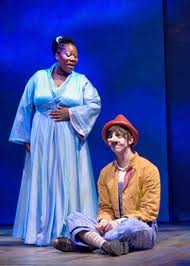
I think Melody Betts in the program should not be the Storyteller but should be the Storyteller/Blue Fairy/Geppetto's Wife. That would be more specific of who she played. All three of those parts were the same person. You didn't know she was Gepetto's wife until the end, but you did know the Storyteller and the Blue Fairy were the same person. I like how she was Geppetto's wife; I thought it was touching and unexpected, and I thought she looked like a very nice Fairy and Mother and Storyteller.
Lampwick is really mean and ornery. Lampwick was played by Dylan Saunders. He sang this song with Pinocchio and the other boys saying, "Terra DI Ragazzi!" I really liked the song called "Terra DI Ragazzi" because I thought it was a cool and catchy song. I wanted to sing "Terra DI Ragazzi" a thousand times in a row. It is about Terra DI Ragazzi which is a fun park with no girls (no fair!) and no parents and no teachers. One reason that I want girls to go to Terra DI Ragazzi was I want more girls to be in this play. And, two, why I don't want them to go to Terra DI Ragazzi (do you like how I say "Terra DI Ragazzi"?) is because they are going to turn to donkeys.
Liz Pazik played the Driver who sang the song with the boys and Pinocchio. She was trying to get them to come to Terra DI Ragazzi. I thought The Driver...it was kind of weird because she said no girls but she was a girl herself. Maybe she auditioned for the part and did a really good job even though she wasn't a boy. And you can't judge by sex.
The scene in the whale was hilarious because Pinocchio said, " I have donkey ears, I have a tail, and I'm in a fish." I thought it was funny because it was getting worse, it was getting worse, and it was getting a tiny bit better. Being in a fish isn't as bad as being half animal because he might be able to get out of the fish.
I liked Don Forston in The Emperor's New Clothes. He played the Emperor in The Emperor's New Clothes. He was really funny; he reminded me of one of my teachers named Mr. Jay. The problem with Geppetto is that Geppetto is a very stupid character. He sends his child away when he is not even a day old. Maybe in that time they didn't have homeschool and it was the only way to get an education. And everybody wants an education. You have to be more than less than one day to start school. He should have waited and not sent him off on his own when he was only a few seconds old! Geppetto learns his lesson at the end. His lesson is 1) don't send your child out when he is less than a day old, and 2) he shouldn't send Pinocchio to school when he only knows a few words and how to sing. Pinocchio should also know how to say the ABCs and stuff like that. Geppetto should have taken Pinocchio with him to get the ABC book. Then Pinocchio could have picked out the ABC book he wanted. Like there could have been one that was white and Dr. Seuss.
Ericka Mac played the Cat. The Fox was played by Derek Hasenstab. I thought they were funny in their parts. There was this funny part where the Cat said "Don't dig up any wooden nickels." And the Fox said quietly, "Wooden nickels. That's hilarious." The way they said their lines was cool because they said that money actually grew on trees, but it didn't. It actually got stolen. They stole it! In the Disney Pinocchio they made the Fox and the Cat kind of creepy, but in this they made them more lovable.
Kevin Depinet was the set designer. I thought it was a cool set. The wheels at the top of the stage turned on with lights and colors and became ferris wheels. And I thought how they did the whale was cool. They made part of the stage open which was the mouth, and then they made it close, and they made red lights for the eyes. Meredith Miller I thought did a good job doing the puppets. I thought it was cool how they used the puppets to tell parts of the story. I thought it was interesting because they go back and forth: so one time Pinocchio is played by a puppet, one time by a human, one time by a puppet.
The people who will like this show are people who like puppets, fairy tales, Italian people, and fast, catchy music. I think this should be for ages two and up. If a two-year-old wants to come and see this, there is one thing they might be frightened of, so beware. It is the whale with the red eyes opening and the mouth. I think Chicago Shakespeare is not only good for Shakespeare; it is also good for children's shows.
Photos: Michael Brosilow

I really liked going to the play Macbeth. It was the first time I've seen it live. It was really fun because even though the witches were the scariest things in the world, I got to talk to the witches and I knew them all. One of them had really long claws; one of them cut off somebody's leg; and one of them was the leader of the witches and she cut off a pilot's thumb. They were played by Sara Gorsky, Danny Taylor, and Lily Mojekwu. In the play they are supposed to have blood running from their mouths when they ate Banquo's soul. I went to this rehearsal because it was a not-blood day.
Matt Kahler played Banquo. Banquo was friends with Macbeth but Macbeth didn't like him after all because he asked somebody to kill him. When he was a ghost he was good at being a ghost because his eyes were half-open and half-shut. When they ate his soul he woke up, and I think he was supposed to be really bloody in the show because they had to tear apart some of his body to get to the soul. Macbeth (John Mossman) said to Banquo "Don't shake your bloody locks at me."
Banquo's son Fleance was played by Brittany Burch. I thought she did a good job dying playing Young Seward. She also played Lady Macduff who was one of my favorite characters. I like dramatic characters. When her son died that was really dramatic. In the scene where Lady MacDuff's son died they took the baby and the children off stage to be killed because the son was played by a girl who was actually a grown-up, Sara Gorsky. Then it would be scary to see real children and a baby be killed. But they are not actually killed--but it would be horrifying to see your child play a character who got killed by two murderers.
I like death scenes, so I liked when Duncan dies. It's alliterative: Duncan dies! You have to imagine that Duncan (Noah Simon) is laying in a beautiful chamber with his two helpers; they kill Duncan offstage. So you have to imagine that Macbeth comes with a dagger, stabs Duncan with a dagger, comes out with two bloody daggers. This is what you can see: Lady Macbeth (Elizabeth Laidlaw) tells him to go back in and put the dagger on Duncan's chest, smear blood on Duncan's face so it looks like the helpers killed him. Then Monsieur Noah the Porter was played by Noah. And he is letting in spirits, and I was a spirit: I was an English tailor. It is kind of weird that Noah was dead like for a second and then one second later he was telling a joke. He was letting in a farmer that killed himself and a tailor that stole from his boss (me). It was funny because he is letting in dead people that actually he shouldn't be letting in. He shouldn't let them in because one of them could commit suicide in front of him and the other one could steal from him.
The final battle: Young Seward dies in that and he is on the good side. And also Macbeth dies. And he's on the bad side. He thinks he cannot be killed because the witches had played a trick on him which is no one can kill him except someone who is born by a c-section. He thinks nobody can kill him. When the people dressed up like trees and bushes of woods, then he thought that the woods were coming closer and that was one of the witches' prophecies that he would die. And when they were coming closer, he hadn't realized that he could be killed by somebody that had been born by c-section. He finds out that he can be killed by Macduff (Jeff Christian) when he gets killed by Macduff. I think you are curious about if Macbeth is ever going to die and then bam! he's dead. I liked the scene where Macbeth dies. I think there was very good fight choreography because it actually felt like you were in a room where somebody was going to be killed in about five seconds.
Lady Macbeth was in the last scene of the play even though she died. She looked so creepy, and she looked so much like a zombie. I thought that was kind of cool. It was like she married one of the witches. In the first scene that you see Lady Macbeth, she looks sweet and kind, but in the next scene when she is trying to get Macbeth to kill the king she was really pushy and mean and evil. I think she was going to have a baby once but it didn't work out. Macbeth just wants to stay like a Duke, but Lady Macbeth wants to be more royal. Macbeth is a kind and honorable man, but then he turns evil and terrible and wants more power. They each want more power because of who they are married to. She wants more power because of her husband, and he wants more power because of his wife. The moral of this story is "don't marry somebody who wants more power."
I think Macbeth is a great play. In the exact first scene with the witches I thought aaah! it is really happening, but then I was like, even though people are being murdered, I know it is just a play. I think you should see a play of Macbeth because it is now one of my favorite Shakespeare plays.
A Midsummer Night's Dream used to be one of my favorite plays because it was funny and it had fairies in it. It is still one of my favorite plays, but not my favorite favorite of all favorites because now I am older and like plays with murders and stuff that is scary. I am not as big a fan of comedy as I am now of drama.
The lovers were Helena, Hermia, Lysander, and Demetrius. They were played by Sara Gorsky, Brittany Burch, Shane Kenyon, and Josh Zagoren. I think Demetrius wants to marry Hermia because she's rich. Hermia, she wants to marry Lysander. It is a love triangle. It actually does make a triangle! (See photo: it means love triangle but with superheroes.)If there are two girls that love one boy or two boys that love one girl that is a love triangle. And there can also be a gay love triangle: boy boy boy or girl girl girl. Or boy girl boy or girl boy girl. When Helena shows up, then the two boys fall in love with a different girl. It is still a love triangle, but with a completely different girl. The funny part was when the two boys, Lysander and Demetrius, were exercising in front of Helena because they were exercising while she was fighting with Hermia. Maybe they thought it would impress her if one of them was stronger or musclier. But people aren't going for muscliest; they are going for smartest. It isn't a love triangle at the end. They each get a girl, but one of them used to not love the other one. Puck was freezing them when they were kissing, and it was a long time that they had to be kissing. They couldn't move. I found that weird. When they were paused, Puck did it and the fairies walked through and they talked and stuff and then it was over.
The fairies were Titania, Oberon, Puck, and the first fairy. Titania was played by Lily Mojekwu. Oberon was played by Matt Kahler. Puck was played by Danny Taylor. The first fairy was played by Elizabeth Dowling. I loved the first fairy--I think for someone for Puck to be in love with--that is a good add. In the last scene Titania and Oberon have fallen back in love, but I think she shouldn't marry Oberon because I think he is a mean fairy because he wants to steal from his wife. I wish that there were more about the changeling boy--like you could see him. I just think if she cared about him so much, she would be with him the whole time. The people in the show couldn't handle a changeling boy because the baby might have cried backstage. And then the baby in Macbeth--which was just a big blanket--wouldn't seem real. Puck was kind of the main fairy in this, and I really liked this actor--even though he was creepy in Macbeth. His performance was good because Puck when he went to go get the flower he actually did it in two minutes instead of 40 minutes. It actually only took 2 minutes to fly around the earth. And that is a world record. Go, Puck! Go, Puck!
There are these people that are in a play and then they put on a terrible play which is hilarious. It is so funny. These people are Snout the tinker (Elizabeth Dowling), Flute the bellows mender (John Mossman: oh my gosh he played Macbeth and Theseus. Oh my gosh. Someone was in a play at their own wedding! Flute was so terrible at Thisby and then the person who played Flute played Macbeth, and he was double amazing!), Bottom the weaver (Noah Simon), Snug the joiner (Jeff Christian), Starveling the tailor (Elizabeth Laidlaw), and the director's name is Petra Quince (Christy Arington). They call her Petra instead of Peter because she is a girl and she's playing a girl character that in another version of the play is a boy. They are not actors. They just got hired to be in a play. And that is why they are so bad! They are not actually actors! When Flute and Bottom kissed they went "eeew" after, so it didn't really seem real.
There's another love triangle! Snout the tinker and the director were both in love with Bottom. I don't know why. Bottom the character is supposed to be kind of weird and he is very bad at his job as an actor. And he turned into a monster. But Noah, the actor, is not at all like that. He is amazing at his job as an actor. Titania falls in love with Bottom because of a flower. And it was a love circle, then, because Titania was also in love with Oberon and there are three girls that like one boy, Bottom.
I would recommend Macbeth for ages 10 and up, but I am a very brave 7 year old. I would recommend A Midsummer Night's Dream for ages 3 and up. Lakeside Shakespeare is a very good company because it is really fun if you are going to a picnic and somebody else wants to go to a play, you can go to a picnic play. People that like Shakespeare, murder, comedy, and fairies and witches would like these plays.
As I am an honest Ada,
Give me your eyes if we be friends
And Ada will review again.