I really thought that the man who played Toad was really like Toad. Mom and I are also like Toad, because we are cranky but we are also laughable. When I was little, and even now, I liked the moment in the book when Toad wakes up and says, "Blah." They put this in the show, so I was very happy! It tells us that he is a pessimist and he likes to say blah, and also that he will be a very funny character throughout the rest of the play. And Frog, also in that scene, is tearing off all these pages from the calendar because one of the winter pages was still on top. That tells you that Frog is kind of ornery but also very sweet because he ripped off the first month of spring page and then it was May (but it wasn't really May, just his calendar said May) so then Toad would wake up. Toad was his friend and he wanted to go out in the spring with him; he wants to be with his friend all the time. That is the thing that is really sweet, but the thing that was ornery was that he said "It is May now!" even though it wasn't actually May.
One of my favorite characters was Snail (Shawn Pfautsch) who wanted to be super awesome and famous and fast. And he wanted to be a mailman. So Toad was feeling sad that he was not getting any mail, and then Frog wrote him a note so that he would feel better and sent it with Snail. And then Snail was being very slow, as snails do, but the thing is he was singing this song that went, "I'm the snail with the mail. I deliver without fail." And it took him a whole year to get over and give it to Toad! My favorite part was when it was winter and he was going under the snow. But the funniest was the movements which were paired with the lyrics, which were: "I'm going to go a little faster now." And then he would start going like he was about to run really fast, but then he actually went really slow. I thought that was a great idea to have that at different random points because it was so unexpected to just put the snail there in the snow! I thought it was fuhlarious; other people were laughing so I thought it was really funny for other people as well as me.
I really liked "Cookies" because it is my favorite story in all of the books and it was perfect! It was perfect because there weren't very many things that were different except for the song and that made it funnier and cooler and the dance moves (by Tommy Rapley) just worked perfectly. I thought the woman who played Mouse (Christine Bunuan) was really funny because she kept asking, "What time is it?" and Toad kept saying to everybody, "My clock is broken." Everybody already knew his clock was broken; he broke it with his shoe in the beginning. I really liked the "Cookies" song because at the end they did this great movement where they threw all the cookies up in the air. The "Cookies" story is about will power, but we don't really know if the author is saying that you should have will power our you shouldn't have will power. He might think you shouldn't have will power because he loves cookies! And maybe he was eating cookies when he wrote the story. The story makes you want cookies! I agree with the second one: EAT COOKIES!!!!!
"Toad Looks Funny in a Bathing Suit" was a really awesome song. I liked it because the bathing suit that Toad wore was actually pretty funny and I thought it was a really good idea to have a giant blanket to be the water and little holes for them to pop out of. I thought that that was a great idea that the scene designer Geoffrey Curley had to make the water but also the snow a big blanket. The song I thought was very catchy and very awesome. And Turtle (Brittani Arlandis Green) sang the song and she was amazing. It has a lesson, which is that it is okay if you are funny. Being funny is a good thing, not a bad thing! Try to find some way you can be funny, even if you don't think you are the funniest thing like some people do. You should have some sympathy for Toad because he doesn't want people to see him but they are still looking. He finds out that he doesn't have to take himself so seriously and he doesn't have to be angry at people just because they think he's funny.
People who would like this show are people who like amphibian friends, catapulting cookies, and very "fast" snails. I think this show should be for ages 2 and up because it is a really fun play for even littler kids because they will get the jokes and these books are books everyone should know. I felt, while I was watching the show, like I was really with Frog and Toad. And when it ended I was sad that it ended. I loved this show!
Photos: Charles Osgood

When you walk into the theatre you see a bunch of people on stage playing music. Even before the show is starting, the actors are playing music. And there were a lot of people from the audience who were on stage hearing them playing. That told me that it was going to be kind of interactive, but I was wrong. Girl came through the audience for her first entrance, but mostly everybody was in the world of the play. I wish that everybody in the audience could have fit on stage. It seems like a play that is small for a big theatre. I think that the set (designed by Bob Crowley) did help make you feel like you were in a smaller theatre. It felt very comfortable and it was also very cool because you could see the actors from all angles no matter where you were because there were mirrors all over the stage.
One of my favorite songs was "Broken Hearted Hoover Fixer Sucker Guy." It was a really funny song and it was about how Guy was in love with Girl but he couldn't marry her. He was also kind of being mean to himself because he was saying, "I haven't done much with my life but I just have to keep on living." That part isn't funny, but the song is really funny because it is so ridiculous. It was also how he played it and sung it. He kept changing moods: sometimes he was a cowboy; sometimes he was a rock man. Sometimes he sang very high; sometimes he sang very low. And sometimes he was just all over the place.
Here is some stuff that I thought wasn't really needed in the play. The first thing is that the dancing I thought was kind of unnecessary. I thought that it wasn't really needed because the dancing was so rare that it just felt unnatural. Dance is about expressing your feelings through movement, but I thought they were expressing themselves enough in other kinds of ways, in acting and singing and playing music. The story is not about dancing; it is about music and how music can bring together so many relationships.
There was a scene I also thought they could have changed. It was the scene when they first met the banker. I thought that it seemed like what would happen if you just turned on Disney channel. It was like something that would "pretend happen" everyday. It was not something that would happen in real life, and this is supposed to be a realistic play, so that didn't work well. The play is not cheesy and you don't know what is going to happen every single second, but in this scene you just knew. I loved the banker character (Benjamin Magnuson) and thought it was a good choice to make him the music shop owner's (Evan Harrington's) enemy. At the end they became friends, and their fights were usually funny. One of the things I really liked about the music shop owner was how funny he was when he was trying to get Guy to get his hands of his "girlfriend." He was doing really weird karate moves.
I thought it was really nice how Girl lived with all of her friends and her family. She has kind of broken up with her husband, but her daughter (Kolette Tetlow) and and her mother (Donna Garner) are with her. Her friends are going to help in the band. Andrej (Alex Nee) represents how sometimes something can go bad, like not getting a promotion, but that playing music can help you cure your sadness. It is kind of sexist because there are no girls in the band except Girl, and after they record Eamon (John Steven Gardner) says "Good job, boys!" Réza (Claire Wellin) should be in the band, but she isn't. She can play violin and she can sing prettily and rockingly! But she is just cast away; her job is to seduce the weird karate guy. But I wanted her to be with them and doing the band.
I really liked when Švec (Matt DeAngelis), who is the friend of the Girl who lives with her, gets really hopped up on coffee when they are at the recording studio. I liked that because it was really funny because he talked about how he needed to go to a coffee shop and was jumping all over the place. That didn't make me think, "Oh, they're going to have the best recording session ever." But how it actually turned out was that they actually made great music, but he just was very loud.
They do "Falling Slowly," which is the main song, at the very end and it is very sad because they will probably never get to see each other again. Everybody was playing it so it was really nice; it made a great closing number. It is not just about sadness; it is about music and being happy when you are playing music. It makes you feel like they should be together because they love each other so much. You are glad that they are in love because they seem like a good match for each other because they both love music and they learn from each other. They have some fun together and they want to help each other.
People who would like this show are people who like music, romance, and hoovers. I think this show should be for ages 8 and up because there is some stuff that you might have to talk over if they were younger, and seven and six year olds don't really like romance. People should go see this show because it is funny but also sad and very musical. The music is really good; it is very beautiful music and it seems like they are singing what they actually feel.
Photos: Joan Marcus

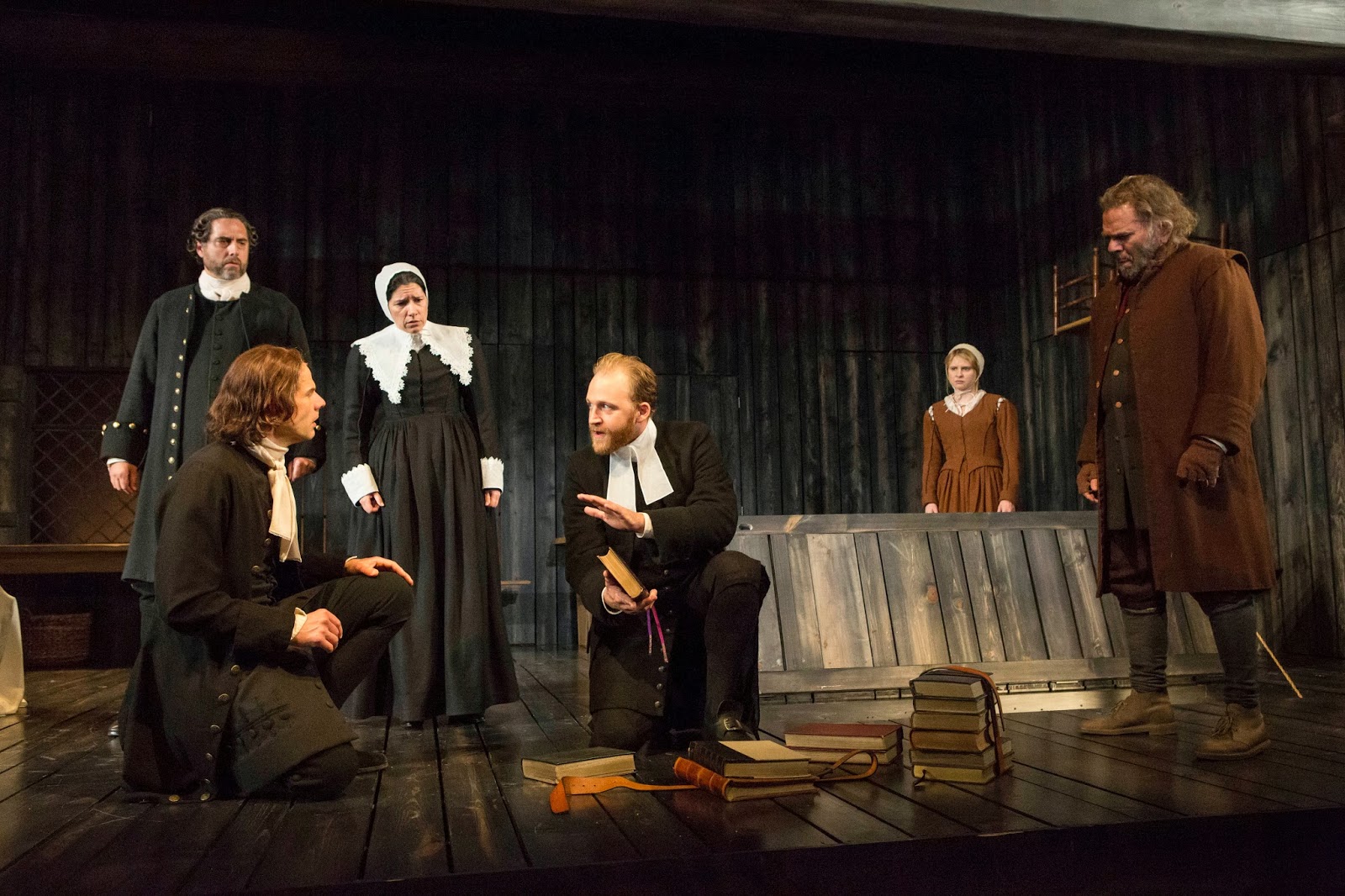
I really liked Tituba (Milicent Wright). She was a slave that was bought from Barbados and accused of witchcraft. She was one of my favorite characters because she was optimistic. She wasn't always like, "Oh! I'm locked up in jail! I will never get out of here! No!" Her attitude was, she was always talking about Barbados and she was never sad about being in jail and just by thinking about Barbados that made her happy, and that made me feel happy for her. She lies that she is actually a witch, but I think it was a good thing to lie at this point because she wasn't like, "I must keep my pride otherwise people will never like me." She chooses life over pride.
All of the girls that accused people of witchcraft were not likable at all, except for Mary Warren (Caitlin Collins) but that was only for a few minutes. I don't mean that all the girls are bad actors; I mean they did a good job of making all the girls unlikable. It all started with Abigail Williams (Isabel Ellison) and Betty Parris (Lola Kennedy) who was getting sick. And you are probably thinking that she just doesn't want to go to school or something like that, but she really just wants attention because in Salem none of the girls were allowed to like boys or play games or be crazy or funny or dance. If I lived in a place like that I wouldn't be that happy either. But if I thought that there was a way that I wouldn't have to be so not understood anymore, I might want do it, but I wouldn't want my happiness to cost many many many people their lives! I think that when Betty started pretending to go crazy because of witches that part of the scene was scary because she got up and just started screaming names and she kept saying "I want to go and see my mother," because her mother had died.
Abigail liked John Proctor (Ryan Artzberger) but he was already married. She wants his wife Elizabeth Proctor (Elizabeth Laidlaw) to be killed or break up with him so she decides she'll accuse her. But when she accuses her it doesn't make him like her more; it makes him angrier at her and not want to marry her even more. One of the characters who I liked at first but hated later was Mary Warren. She was one of the girls in the group and when she came home to her masters, John Proctor and Elizabeth Proctor, she told them about the witch trials and there was this pin that was stuck in this doll that she made for Elizabeth. And everybody thought that Elizabeth had done it to hurt Abigail, but Mary knew that it wasn't true. So Mary tells John Proctor and John Proctor makes her go to the court. And at the court she says, "Ok, we have not been actually seeing witches. We just wanted attention and we're sorry." And then the girls--Abigail, Betty, Susanna Walcott (Kendra Obermaier), and Mercy Lewis (Allison Prein)--start saying, "Oh no! There's a bird! There's a bird! It's about to pounce!" And then Mary Warren says "I see it too!" And then they start screaming and running around the room. Not a very pretty sight. I'm mad at Mary Warren because I really liked her for doing this for John Proctor, but then if she doesn't actually do it I don't like her that much. She probably changed because she wanted Abby to still be her friend.
John and Elizabeth are not the best two to get married I think. I think that they weren't such a good pair because he didn't seem that grateful about the things his wife did. He had an affair with their servant just because Elizabeth was sick! And he also lies to his wife a lot. And when she makes food, he doesn't just say, "Mmm. This is good." He has to sneak into the house and put a weird something spice on it. And then he'll eat it. He is a very picky eater. I understand why he treats Abigail in a mean way--because it kind of seems like she kind of was like "Your wife is sick, so why don't you come have an affair with me." And he gets even meaner to her when she starts the Salem witch trials. I really liked the character of Elizabeth because she was kind of cranky but she also seemed sweet and I thought that if she hadn't been the wife of John Proctor she wouldn't have been as cranky as she was.
The scene where John Proctor made a big decision was really scary. He only has bad options. His decision is to get killed. I think he did that because suddenly he didn't want his name clapped up on a door saying "I have done bad things. No one should come near me." By choosing to be killed, I think he is actually happier. He's saying to the judges: "You tried to make my life a horrible place, so I don't want my life anymore." It is sad because I think that Elizabeth Proctor found that she actually loved her husband.
All of the reverends and judges were not good reverends and judges because they really believed that the devil was actually working around Salem village and that witches really exist and were helping him to do bad things. The people who actually do the bad things are the reverends and judges because they listen to the girls and they execute the people who are accused or press them to death. Reverend Parris (Rob Johansen) I think he seemed like he was sometimes nice to his children but his problem was that he, according to the play, only preached about candlesticks in church. That showed us that he was really only doing this preaching stuff so he could have money. Deputy Governor Danforth (Stephen Pickering) was a very mean character because he was always yelling at people. He allowed John Proctor to get killed even though he didn't believe the girls anymore. I thought that he seemed like somebody who, if a little homeless baby came up to him and asked for a penny, he would slap her in the face. He seemed like a person who would say no to everything, except if it was like, "Let's go and kill someone!"
Reverend Hale (Dennis Grimes) was not very likable at all at first because he really believed Betty Parris and he came to visit John Proctor and wasn't exactly very nice. Then later in the play, after he had given Mr. and Mrs. Proctor the bad news that she had been spoken of in court, I think he kind of gets a soft spot. He starts getting nice because he feels like he has just killed a bunch of innocent people. He is like, "I have done something wrong. I have to do something to help the people of Salem who I have hurt." I was not expecting him to turn into a nice guy. I thought that was a really good decision because then you actually have someone who you actually trust in the play. Reverend Hale shows us that it is not good to say, "Well, I don't want to admit that I am wrong" like Danforth. Miller is saying, "People have to start saying that they made mistakes because otherwise more people will get hurt."
The lights (designed by Jennifer Schriever), whenever something bad was going to happen, you knew it was to going to happen because the lights went darker. And even when something just was weird they would have a light effect for it. I thought it was good to have different light effects for different emotions you were going to have. The sound (designed by Fabian Obispo) at the very end when John Proctor was getting executed was like a big snap! I don't really know what the snap! was but I think it had something to do with the rope or his body. It made me feel really scared, like it was happening to me or that I was witnessing it.
People who would like this show are people who like everything dramatic, freaky little girls, and golden candlesticks. This show is not in Chicago. It is in Indianapolis. People should go see this play because it is a really scary but awesome experience. I would recommend driving down there because it is great place and the theatre is really great. And this play is totally worth going on a four hour drive for!
Photos: Zach Rosing

There was a song called, "Eva, Beware the City." When Evita went to the city she was in love with this lounge singer named Magaldi (Christopher Johnstone). I don't think he was as good a match for her as Perón. And he kept saying, the city is too dangerous for you because you are a woman. It wasn't true, because women can live in the city. I live in the city! My mom loves in the city! A bunch of women that I know live in the city! I liked this song because it had great choreography. I really liked when they had little dance parts when Evita went with one man and then another man and then another man. It told me that she really liked any kind of man, no matter who they were, no matter what they did; she liked men.
"Good Night and Thank You" kind of made me feel uncomfortable because Evita was having a bunch of affairs with all these men who came to her door. They showed that she was having the affair on stage by going into this little room that was on stage, and wearing these little bedroom robes. Most of the men gave her something; like some of the men gave her bedroom robes, some of the men gave her chocolates, and some of them gave her flowers. She was interested in the men and the presents I think. Che (Josh Young) was singing with the men even though he wasn't having an affair with her himself. But he still kind of felt what it was like, even though it wasn't happening to him. He was kind of telling the men, "I'm sorry about this, but it happens." That's basically what he said to every one of them. I thought that Che was a really great singer. He could hold high notes a really long time and wasn't like some kinds of high singing that are ear-piercing and unpleasant. I did like the character. Even though he was against Evita, he was the character you were always with. You kind of question Evita for the things that she had done just because you knew this other character. When Che didn't like her, we didn't like her, and when Che liked her, we liked her.
There was a really great song called "Another Suitcase in Another Hall." It happens when Evita is coming home with Perón and finds Perón's mistress (Krystina Alabado) and tells her to get out. I liked the song because the singer was really amazing. You felt it was something that really happened. You didn't think, "this is just a song"; you thought, "this really happened to this girl." You really felt sorry for that character. You kind of liked her better than Evita, even though she wasn't as big a part. The song made be think differently about a lot of characters. Like Evita throwing her out made me feel like Evita was a horrible person. And the narrator Che I didn't like at first, but then he helped this girl and it made me think differently about him.
There are some people who like villains better than the heroes; like my three favorite characters from Batman are Catwoman, Harley Quinn, and Poison Ivy. Evita kind of is a villain because she does bad things, but she is also a hero. She was good with government stuff and she helped the poor through really hard times. People loved her because she said, "I want you to be like me and I want to be like you. I'm not better than you guys. I think all of us are equal." I think she wasn't just saying that. She used to be very poor, then she fell in love with a man and got rich. But she still didn't always think of herself as better than everybody else or upper class. "Don't Cry for Me, Argentina" was about how Evita didn't want people to think of her as upper class. She wanted them to think of her as just like them. I really liked that song. I thought it was really pretty and really well sung.
"Rainbow Tour" was about how Evita was going on tour to say "Hi" to different countries. And it started out well in Spain but it didn't go so well in any of the other countries. Especially Britain. She got on these suitcases when she got angry at Britain and she threw them around. I think they wanted to show you what Evita was like when she was angry. That kind of made me feel sorry for her, even though she wasn't exactly such a good person. You kind of did feel sorry for her when she died, but I was angry at the writers for making Perón say this giant "Noooooo!" when Eva was dying. I thought that was kind of cheesy and it made me mad for the rest of the play.
People who would like this show are people who like drama, great singing, great choreography, and suitcases. People should go see this show if they are interested in learning about Evita and Perón and what she did for her lifetime. I think it is really good because it makes you discover what it is like to have your favorite character be a minor role and the main character be an interesting character but not be very lovable.
Photos: Richard Termine

The first scene of the play started out with Julia Child arriving in France. She was trying to speak French, but she wasn't very good because she was speaking in an American accent while speaking French, and I thought that was really funny because she was like "We" instead of "Oui." And when she sat down with the wine, and her husband was testing it in this very French way, she tried to do it in a French way too, but it was her first time ever doing it, so it was like, "Oh! I guess I'm supposed to do this?" She seemed kind of jealous at one point because when they came in a woman, Madame Dorin (Jeannie Affelder) came up to Paul and hugged him. It tells us that he had a lot of friends in France and she would have to get used to him having all these friends. She is among strangers.
There was a Belgian lady whose name was Madame Brassart (Janet Ulrich Brooks) and she was being really mean to Julia Child because she didn't really like her because Julia Child wants to have a cooking class and they want to put her in this beginners' thing but she doesn't want that class. She thinks she is too good for that class because she wants to become a great French chef and the other people just want to learn to cook. I think that character is a good character to have in a play, but I am not sure I'd really like to know her. Avis was played by Janet too and she wanted Julia to be able to have a great cookbook. I thought that she was a great character to have in the show as well and she seemed like somebody I might want to be friends with in real life because she was very helpful to everybody and seemed really optimistic. She was optimistic that other people could get through hard times and get to their goal.
One of my favorite characters was Julia's teacher (Terry Hamilton). His name was Chef Bugnard and he was a really good example for Julia because he teaches her what time artichokes are good and why you shouldn't broil an old partridge. He teaches her to think about how you should have feelings for food even though it has never spoken or said what it wanted. He teaches her not how to speak French language but more what France is really all about, and that is their delicious food and how it is a place where you discover what you really want to do. I thought it was funny how he was always stroking his mustache. Another funny thing that he did was even when he was just saying scrambled eggs, he did it in a very fancy way.
I loved Simca (Jeannie Affelder), Julia's really good friend who decided to start a class for cooking with her. She was the one who asked Julia to help write the cookbook with her. She was one of my favorite characters in the play, probably because she had one of my favorite lines, which was: "I will speak French very fast. It will be fun!" I love cranky French ladies! Nice French ladies are fine too, but I especially like the cranky ones. Julia wants to make the cookbook readable to the Americans and Simca wants it to be more authentic, completely French. They are a very good team, even though they want different things.
Paul would help Julia do anything, and I think if she were with anyone else, she wouldn't have had a good time in Paris. I think that their relationship was really beautiful but also they had some fights. It wasn't like they were always happy with each other, but they always would love each other. I know that they would never ever break up. One of my favorite scenes was when she got angry about how for her test at the cooking school they only asked her to do things that were not hard. She wanted a challenge. So then she makes a bunch of food at home that she had to make a list of the ingredients for the test. She makes "the biggest vat of crème caramel that anyone could ever imagine." And she gets really really angry and she has never been so angry in this entire play. And Paul asks her "Where's all the food?" and she says, "I ate it." I really liked this part; these are two of my favorite lines in the play!
When the government made Jane (Heidi Kettenring) not be able to leave America, it made me really really angry. She used to be a communist but it wasn't like she was the leader of all the communists. She was just a communist. She is not doing anything bad; she is becoming an artist. She was probably a friend that was put in the play because she had the most interesting story. It shows us that the Childs are very tenderhearted. They simply want to defend their friend. It is okay to think that the government is wrong. It wasn't seen as okay in that time, but in this time it is.
People who would like this show are people who like food, France, and fun! People should go see this show because it is funny but also you feel really angry and sad sometimes but also you feel really happy for Julia when good things happen to her. It helps us to remember to never give up. Just because you are really bad at something at first doesn't mean that you can never learn how to do it. She loves doing anything; she is never like, "This is not fun." She is always like, "This is fun!" I really wish there was a sequel because I want to see what it was like when she was filming her cooking show for television. I know it would be funny!
Photos: Giorgio Ventola

I really liked the part where Wilke (Morgan Maher) was drunk. It is not that I think seeing lots of people drunk is funny; it is that I think the lines are hilarious. There was this line that I thought was really great which was said by Hollow Tom (John Henry Roberts). Wilke said, "Do you cook?" and Hollow Tom said, "Do you like beans?" And then Wilke said, "No." And then Hollow Tom said, "Then, no." That was really funny because all this person cooked was beans and nothing else. I also really liked when Abraham (Christopher M. Walsh) said to Wilke, "Are you done?" and Wilke was kind of squeaking "For the moment." Wilke's a tough Viking, but he's not acting like a tough Viking; he's acting more like somebody who is absolutely not a Viking.
Last year I thought Irek Obsidian (Tracy Letts), the dragon, was really awesome but this year I think he looks even awesome-r because--well, that's a secret for now. I want you to see him yourself. I thought that the gun that Ben Hertel used was really funny. It wasn't like a small little handgun. It was a giant enormous machine gun and it was really funny because he started bouncing up and down like really fast, and then he was like shooting at the other people. It was really funny because it came out of nowhere and he just kept shooting shooting shooting. I really liked the bird puppets (designed by Rachel Watson). They were really interesting because the were puppets but they looked like robots.
There were a bunch of scenes that I really liked where Abraham was being really funny. He had a lot of scenes where he was being hilarious, so I'll just tell you about a few of them. I really liked the part where Casper was giving his big speech and Abraham said, "I really liked the part where you raised the hammer," which means, "I didn't hear anything else that you said, but you raised the hammer." He didn't hear it because he had a hearing trumpet and it wasn't out during it so he didn't hear it. I thought it was really funny when Abraham came out and he pointed to Zeke, who was in the audience who played Abraham last year, and said, "You look familiar!
"I thought that it really gave the plot a good drama to have romantic conflict between July (Kay Kron) and Rienne (Paige Collins) because they both like Casper. I think Rienne had to love Casper a little bit because there was a whole romantic kind of flirty scene. But she also cares about Wilke like Casper cares about July but also cares about Rienne. Like he cares about both of their safeties, but he also cares about his entire kingdom's safety. So it is hard to choose between his girlfriends and his kingdom because he loves both of them.
There are four storytellers now, even though in The Iron Stag King there were only three. The three were July of the Seven Foxes, Irek Obsidian, and Hap the Golden (Cliff Chamberlain). But this time Casper is a new storyteller. I think that because he is kind of like a storyteller in training because he doesn't know all the spells or anything but he does know that he can tell his own story. He doesn't need to be told by another storyteller. I think that that is cool because you weren't exactly expecting him to want to be a storyteller, because he hates the storytellers. But he wants everyone to be their own storyteller. He wants to tell other people's stories but he doesn't want to be the only person who can tell those stories.
The villain in this story was Davy Boone (Blake Montgomery). He was kind of the villain because the main character is against him. But he is not the villain because he kind of has a better idea of what he should be doing in this battle. He thinks he should be fighting for his people, not having people fight for him. He is not exactly smart, but he is not exactly dumb. He has the right ideas, but he doesn't really have the right ideas to win. He has the right ideas to protect his people from getting killed for the moment, but I don't think it is exactly the smartest idea to just bring yourself and a few other people you know on the journey instead of bringing an army.
Olympia (Brenda Barrie) is a new character. She was not in the first one. She is the new Lady of the Grass. I think that she is kind of a bad person but she is also kind of a good person. Like she does hurt Hollow Thom, but it is for a bunch of people's good. She used to be a playful young girl, but then she turned serious. There is this scene where they talk about a toad that was put in her bed. She reacts very little-girly, like, "Ah! There's a toad in my bed!" But then she throws it into the fire. And that is just a girl who gets things done, not a girl who screams because there is a toad in her bed. When she's talking to Hollow Thom she is behaving like a girl who gets things done but also a girl who wants information. She's acting like she's throwing the toad in the fire. I think she didn't really want to whip Hollow Thom because she feels like maybe even though he killed a bunch of her relatives he's changed a lot.
People who would like this show are people who like dragons, storytellers, hammers, and ear trumpets. People should go see this show because it is intense, lovely, and fun. If you haven't seen the first one in the trilogy, there are going to be readings of it on September 15 and 21st, but you don't have to see The Iron Stag King to understand The Crownless King.
Photos: Michael Brosilow

I thought that the parent videos were really funny because most of the time they talked about things their kid did when she was little. I liked when they talked about her being a beaver in the school play because it was funny. Sometimes even if old people aren't that old they are different from you so it is kind of funny to you how they talk and how they act. There was this really funny part that I liked where Jim was kind of flirting with his wife on camera and I thought it was interesting because you felt like you actually knew these people. That showed that they were happy being husband and wife.
There was this kind of disturbing part where Bron came out in a chicken mask and a white unbuttoned dress and there were these chickens on the screen behind her and blood started coming out of her mouth. And she started smashing all these eggs, and as she smashed the eggs there was a closeup of a chicken laying an egg, and it wasn't that far back; it was up close with the egg emerging from the chicken's body. I think that that was supposed to be a joke because she said "If you are not doing this, that means you aren't doing theatre." There are many many plays, and almost none of them are all about chickens laying eggs and blood coming out of chickens' mouths! It is a joke that says that theatre can come in many different ways, and sometimes it is weird.
I liked the part where Bron dressed up like a beaver and came out in this beaver costume and got a can of beer and opened it and started to drink it. And then she said, I need a volunteer. Then she said, "Well, here's your script. You're going to be me, and we're going to clear something up with my mom. My mom will be played by my mom," as she takes out her telephone. I thought that that was really clever because she just called up her mom in Australia and the volunteer had to read the script. And I won't give the speech away to you, because it was really funny. It showed me that art can be sudden and what you expect cannot always be what happens.
The blue paint was weird but awesome. Bron came onstage in a white outfit and was dancing this dance, and a little bit later when the dance kind of went crazy she just rolled around and somehow she got all this blue paint on her. It was supposed to be like one of the exercises that they did in dance school that she talked about in the first parent video. The parents didn't really get it at first, and then they kind of got it a little later. She was supposed to pretend that she was rolling around on the floor and she had to get herself covered in the blue paint. She wanted to do it literally and not just figuratively. I think the audience is supposed to feel like her parents and her parents feel like, "Oh, now I kind of understand it."
People who would like this show are people who like beavers who have beer, chickens, and blue paint. People should go see this show because it is funny, touching, and educational. Go with a parent like I did! They will probably like it and then you can talk about it while eating cream puffs because that is what me and my mom did.
Photos: Max Milne Photography