I had so much fun interviewing the cast of Tootsie. It begins performances September 11th at the Cadillac Palace Theatre. I can't wait to see the show!
Friday, August 31, 2018

Thursday, August 30, 2018
Broadway in Chicago's Summer Concert at Millennium Park

I really loved the performance of "What Would I Do" from Falsettos by Whizzer (Nick Adams) and Marvin (Tally Sessions). That song always makes me very emotional because of how important these two characters are to each other even though their relationship has not been perfect all the time. I've only listened to the soundtrack, so I am really excited to get to see one of my favorite shows this season.
I'm really interested in Miss Saigon after seeing Emily Bautista's breathtaking performance. She sang "I'd Give My Life for You" with such passion and amazing vocals. It seems like a very dramatic and tragic story, and I'm excited to cry in a theater with a bunch of other people!
"You and Me (But Mostly Me)" from Book of Mormon, sung by Elder Price (Kevin Clay) and Elder Cunningham (Conner Peirson) was really hilarious. I didn't see Book of Mormon the last two times it was in town because it probably wasn't appropriate for an 8 or a 12 year old. Elder Price and Elder Cunningham's relationship was really funny and I'm really excited to see the entire story of this musical I've waited so long to see.
I'm so thrilled Dear Evan Hansen is coming to Chicago. I'm a fan of the soundtrack, and I'm really looking forward to seeing the story that goes with it. I thought that Ben Ross did an amazing job with "Waving Through A Window." His vocal range is amazing and I'm interested to see what he does with the character. It was really moving to see all the nominees from the Illinois High School Musical Theatre Awards join him to sing "You Will Be Found." It was just awesome to see the star of a touring company singing with all these people who want to make musical theatre their career.
Photo: Broadway in Chicago
Monday, August 13, 2018
Review of The Story Theatre's Leave Me Alone!

I really like Chekhov's writing, but there is not a great representation of people who are not white, straight, and depressed in his plays. So I really liked that this play represented people of color and the LGBTQ+ community in the writing and casting. Everyone still seemed pretty depressed. I also really liked that two of the primary relationships (between Dr. Love and Anna and Ivanov and Sam) were gay relationships. I thought the actors in both of those relationships were really spot-on and their performances made me emotional. But I found it strange that their sexuality is very accepted by everyone in the play. I really wish that was the case in the world, but we aren't there yet. I was expecting to see a representation of how people get treated in the world because of their sexuality, even by their own families. But it is also nice to see a play that isn't primarily about the struggle. The attacks on Ivanov and Sam's relationship are about age, not about them both being men, which I think is good to focus on, but in the playwright's note it says this play is about how we haven't come so far since Ivanov's first production. But I think it is very different from how many gay people would have been treated back when the first production of Ivanov was happening. Also everyone seemed to hate Dr. Love, but not because of her sexuality. They hated her because she was too perceptive and noticed all their crap.

People who would like this show are people who like gayer Chekhov, perceptive characters, and a little vacation from the So-over-it Union. I think this is a really powerful show and I think this was a really good Chekhov adaptation. This show only had a two-week run, and I'm so sorry I couldn't get the review out before it closed. I'm looking forward to what this company does next!
Photos: David Hagan
Wednesday, August 1, 2018
Review of Eclipse Theatre Company's Bus Stop

The general problem with the script is how Bo can physically and verbally abuse someone and she will forgive him and say, "Aw, never mind. He's really cute though isn't he?" Which is problematic for so many reasons. One of the reasons it is so troubling is because it seems to be saying that he was just so in love with her, he had to kidnap her, which isn't a good excuse. I also feel that the way that Bo is supposed to learn his lesson is disturbing: by getting beaten up by the Sheriff. In this production it was particularly distressing to watch because of the current violence against black people by law enforcement in America. I'm not sure if we were not supposed to think about race, but it is hard not to when a white sheriff is beating up a black man and no one is standing up for the victim and we are supposed to think everyone just gets along okay afterwards. It is not like Bo hadn't done anything wrong, but there were better ways to prevent him from bothering Cherie. I also found the answer to the question that Grace asked Carl after they had had a night together--if he was married--was a little late to ask that. And also he did not ever give her a yes or no answer, which is what you call a red flag. I don't think relationships have to be perfect examples in plays; bad relationships can be interesting to watch on stage. But if they aren't examples of good relationships, I don't like to see them placed in front of you as fine.
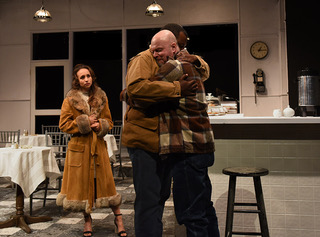
I do really love the mentorships in the show. They really bring some lovely non-romantic relationships into the storyline, which is so full of romance. I really love the relationship between Elma and Grace. They seem to really help each other out, and Grace treats Elma as a sister and tries to teach her and help her to become a self-aware person. They also had really cute jokes they had together, like how Grace didn't like cheese so she never restocked it. I also really love the relationship between Bo and Virgil because you never really get to see Bo be vulnerable or not try and be the strong, manly cowboy that he usually is around anybody else except Virgil.
People who would like this show are people who like significant mentorships, nonexistent rope tricks, and a lack of cheese. I think this is a really interesting show to watch. It has really great actors and a compelling storyline. It just has some old-fashioned and misogynistic ideas that I'm not a huge fan of.
Photos: Scott Dray
Monday, July 30, 2018
Review of Brown Paper Box Co.'s Everybody

Everyman was a Christian, gendered morality play, and Everybody is a non-gender-specific, not-religion-based morality play. I think Everyman really needed an update, and this is exactly what it needed to be to show a story that everyone could relate to. The play shows the inclusiveness of it by the audience not knowing who will play who at the start of the show. You don't even know at first who is the audience and who are the actors. I found that interesting and exhilarating. I had no idea what was going to happen, but I was excited to find out. I think allegory is a good way to tell this specific type of story, where there are a lot of moral questions. Allegories make things that are not people into characters to make the ideas more understandable. The moral of the story, in my opinion, is accepting your life, accepting your body, accepting that terrible things will happen to you, accepting that you are going to die, accepting that people who you love might not love you back. That is not the most depressing thing it the world because you are accepting it, and it is just part of what is going to happen. The rest of your life could have some really amazing parts to it, but there are going to parts of it that we aren't going to like. There are going to be things and consequences we aren't going to like. Acceptance is important because without acceptance you are lying to yourself and as with any lying it will make you sadder in the long run.
There was a very interesting scene where Love was first introduced and made Everybody completely humiliate herself by taking her clothes off and running around saying how much she has disappointed herself. You don't expect Love to completely humiliate someone, especially when it is anthropomorphized, but it is probably realistic. Usually the kind of love that might lead you to humiliate yourself is romantic love, but I feel like the character of Love in this play is not just romantic love. It is showing all the kinds of love in one. He comforts her afterwards and stays with her until he can't anymore, until the very end. That shows how devoted love can be even though some kinds of love can humiliate us.

People who would like this show are people who like relatable plays, evaluating humiliating love, and hilariously ominous dream ballets. I think that people should definitely go see this show. It is an amazing experience, and I really loved it.
Photos courtesy of Brown Paper Box Co.
Thursday, July 26, 2018
Review of The Color Purple (Broadway in Chicago)

There were two moments in this show that I think were really inspiring and powerful, the song "Hell No!" and the scene where Celie curses Mister. "Hell No!" was a song sung by Sofia about Harpo raising his hand to her. It is about how she has had to fight for herself her whole life, but didn't know she'd have to fight in her own home. It is about the experiences she had with the male members of her family, and her response is "Hell No!" She has over time realized what Celie hasn't yet, that she doesn't deserve to just take it. I really liked this song because Sofia was stomping across the stage and was so powerful. The singing was really amazing; she had this really great belt and a crazy range. It is really strange to me how Celie can remain so calm when people are furious and yelling at her; I think that shows that she feels that she is getting what she deserves even if she doesn't know or understand why, which is really sad. Celie does eventually figure out that she doesn't deserve to be treated the way she is and that she deserves better. And on the day that she is leaving she decides to tell Mister what has been on her mind for the years of their "marriage," which was a legal but not emotional relationship. She ends up cursing him and saying that everything he touches will crumble until he does right by her. It is justice in the package of a curse. Sofia had the best reaction to when Celie first stood up to Mister; it sounded like she was crying at first and then it eventually started sounding like laughing, and then it was full-on howling. It was great to see how Celie breaking out of her shell inspired every woman at that table to say she didn't need to take any crap.
This show is mostly powerful and heartbreaking, but it also had a lot of great comedic moments. There is a song called "Any Little Thing" sung by Sofia and Harpo about how when all their various children were out of the house and they had done all of their chores, which they would sing about to each other in a very suggestive way, they get a little private time. One of the reasons it is so funny is that it is such a quick turnaround from talking about chores to making it seem like you aren't talking about chores anymore. Also their extreme enthusiasm about no one being in the house is absolutely hilarious to watch. This song is also extremely adorable and shows you how healthy the sexual element is in their relationship. It is healthy because they are both trying to do something for the other person instead of trying to get something themselves.

People who would like this show are people who like inspiring stories, power pants, and suggestive chores. I think that people should definitely go see this show. It is a powerful, surprisingly funny, heartbreaking, and heartwarming show. I loved it!
Photos: Matthew Murphy
Wednesday, July 25, 2018
Review of The Roommate at Steppenwolf Theatre Company

The relationship in this play is very complicated because it is not just a friendship, or a romantic relationship. It is not just a business partnership, or a two-way mentorship. It is all of those things. The play made me uncertain about what person in the relationship was responsible for making it eventually toxic. It seemed like the relationship made each of them more happy, even though they were doing some stupid and hurtful things. So you end up rooting for it. There are not a lot of plays that I have seen that are about middle-aged women building a relationship with each other. I liked how complicated their relationship was and how it showcased how women relate to each other outside of family relationships or relationships centered on a man. At the beginning of the show, Sharon was very scared about letting a new person into her life and into her home that was not from her community, and at first it is really beautiful to see Sharon embracing herself and the things Robyn has introduced to her. And even though it becomes disturbing, it is a very valuable relationship to both of them. I think the playwright is trying to show that it is good to go out of your comfort zone and that the relationship that Robyn and Sharon have is important, even though it might not be the most functional. I liked how it didn't have to be all sappy, like two middle-aged women help each other realize that their lives aren't over. It is empowering--not through sap--but through dark humor and heightened realism.

I think what is so great about heightened realism is that it keeps you thinking that almost anything could happen, but it still seems to take place in the real world. Robyn and Sharon are both women with children who live in Iowa and got divorced. That seems very normal. But then you discover that they are more complicated than you think. It is fascinating to watch people who seem like they have average lives discover their dark underbellies. You are still in the realm of reality, so you think this is something that can happen in my own life. You understand where the people are coming from because they are in a world you recognize and some of the circumstances are recognizable, but it is exciting to see extreme situations that you probably haven't been in yourself.
People who would like this show are people who like twists on tropes, unexpected friendships, and telling your son you smoked weed. I think this is a surprisingly moving, funny, and inventive melding of genres.
Photos: Michael Brosilow
Subscribe to:
Posts (Atom)