Friday, March 11, 2022

Review of Hadestown (Broadway in Chicago)


Once upon a time I went to a show and it was called Hadestown. The music, lyrics, and book were by Anaïs Mitchell and it was developed with and directed by Rachel Chavkin. The music supervision and vocal arrangements were by Liam Robinson and the choreography was by David Neumann. It was about Orpheus (Nicholas Barasch) and Eurydice (Morgan Siobhan Green) who met at the railway to Hell. Hermes (Levi Kreis) encourages them to fall in love and narrates the story to the audience. Persephone (Kimberly Marable) has returned up above bringing spring with her and leaving Hades (Kevyn Morrow) behind, but as Orpheus and Eurydice fall more deeply in love, Persephone reluctantly prepares to return to the underworld. This show explores love, trust, and capitalism through heartfelt music, dynamic movement, and detailed character work. 

I love how intimate this musical feels even though most of the theaters this production will be playing in seat hundreds of people. The cast creates this bond with the audience from the first moments and it is palpable throughout. At the beginning of the show, Hermes introduces us to all the characters we will see. Kreis made a point of making the audience feel like he was connecting with every single audience member through directing his lines not only to the people in the front row but also to the balcony. This gave off a very presentational energy but the actor's high intensity didn't make the message or storytelling feel any less genuine or personal. This is something I have rarely felt in a large-house show. Marable as Persephone also had a really great connection with the audience and the ensemble. As she was making the people at the railroad station fall in love with her, the audience was enamored too. Her energy was so welcoming and she took moments to glance at the audience and wordlessly joke with them about the events on stage. 
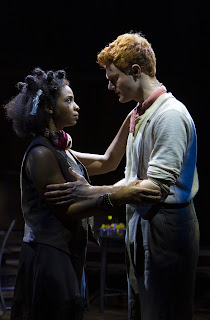
I absolutely loved both the style and execution of the movement in this production. It was very fluid and felt like every movement led into the next. It had a lot of attack and seemed very passionate.  There was a compelling contrast being the way the gods moved and the way that Hades's workers (Sydney Parra, Will Mann, Lindsey Hailes, Jamari Johnson Williams, and Chibueze Ihuoma) moved. Hades's workers were very uniform and regimented in their movement. And even when they were not moving together, it felt like they were staggering the same movements. This constant movement during most of the second act from the workers made for an intense and realized atmosphere, which kept the fact of their roles as human cogs in the capitalist machine present in the minds of the audience. On the other hand, the gods and the Fates (Belén Moyano, Bex Odorisio, and Shea Renne) had a jazz-based and exuberant movement. The gods are usually very poised and celebratory, however, as Persephone is having an internal battle about her relationship with her husband, Hades, she starts to convulse, using her movement to demonstrate the torment she is going through. This was not a side of Persephone we viewed when she was on the surface with humans; it is only apparent in the underworld. This was very effective and made her a more complex and lovable character. 

I really connected to and was impressed by the metaphors present in this play, especially those referring to self doubt. The myth has always seemed to me about a lack of trust in one’s partner, but here it feels more about lack of faith in one’s self. Within this production the Chorus of Fates represent many internal debates that the humans go through. However, the one that ends up feeling the most crushing is how Orpheus slowly and brutally loses all the confidence Eurydice has built up in him across their tender and heart-wrenchingly beautiful relationship. Orpheus is then separated from the thing he loved most because of his own self doubt and fear of not being enough for Eurydice. This reflects one of Eurydice’s critical moments earlier in the play in the song “When the Chips are Down.” The fates circle and entrance Eurydice into selling her soul to Hades, both literally and figuratively. This song’s harmonies are so tight and mesmerizing that it begins to have this hypnotic effect on the listener as we start to question the very relationship between Eurydice and Orpheus that we have grown to support. It can be very difficult to have a characters function symbolically without seeming contrived, but the Fates do an excellent job of being complex and frightening while also adapting to the emotion or gut feeling they are portraying at the time. 

People who would like this show are people who like hypnotizing Fates,large spaces with a lot of heart, and gods going hard on the dance floor. I am such a fan of the music in this show, and watching these amazingly talented actors bring that music and story to life is an absolutely transformative joy to watch.
Photos: T Charles Erickson

Wednesday, December 1, 2021

Review of Paradise Square at the James M. Nederlander Theatre


Once upon a time I went to a show and it was called Paradise Square. The book was by Christina Anderson, Marcus Gardley, Craig Lucas, and Larry Kirwan. The music was by Jason Howland and the lyrics were by Nathan Tysen and Masi Asare. It was directed by Moisés Kaufman, choreographed by Bill T. Jones, and music directed by Jason Howland. It was about Paradise Square which was a neighborhood in New York City that was home to many discriminated-against groups during the Civil War era. The musical focuses on Nelly O’Brien (Joaquina Kalukango) as she tries to navigate running one of the most popular bars in the area, sheltering escaped enslaved people, and the draft riots and the effects of the civil war on her family. It is a riveting, reflective, and socially relevant celebration of home, diverse cultures, and the dance and music that help get us through hard times.

I loved how much dance is a part of this show. The combination of Juba and Irish dance styles blended with contemporary dance accented the period well and was a great celebration of the mixing of cultures. The dancing was beautiful but also parallels the social unrest in the period. Two of the main characters are Owen (A.J. Shively) and Washington Henry (Sidney DuPont) who are both new to Paradise square. Washington Henry has escaped slavery and Owen has escaped famine in Ireland and both of them share a passion for dance. I really enjoyed watching the process of them discovering each other’s dance styles and picking up techniques from one another. They start to perform together, but eventually they are forced to compete and find themselves battling over who deserves the prize money more. This competition powerfully symbolizes the catalyst for the draft riots, where the disadvantaged fought among themselves, prompted by the rich and powerful Anglo-American political leaders. I really enjoyed how the dance was connected to the overall themes of the show. Sometimes in a dance number in a musical, the plot ceases to move along. It is interesting to watch but it doesn’t make a point. But here they use dance as a plot device not as a “break.” 

 “Breathe Easy” begins with Angelina Baker (Gabrielle McClinton) singing to herself, waiting for her lover Washington Heny to come find her. I think McClinton’s performance was intimate and very moving. At first it felt like Angelina was unsure if she could get through this and be free with the person that she loved, but as more and more voices joined her, including the voice of Washington Henry, you saw her determination and confidence grow. As she is surrounded by those who came before her, encouraging her, it felt like the room had been transformed and everyone was focused on the storytelling that was happening onstage. The reason why “Breathe Easy” has so much impact is because even though Washington Henry and Angelina Baker have escaped slavery and found each other again, the play doesn’t neglect to reflect on and remember the people who were not able to escape or survive. Even though this musical focuses on the hope and relief that came for Washington and Angelina, it doesn’t forget the disgusting and tragic truths.

My favorite relationship in this show was the one between Nelly O’Brien and her sister-in-law Annie Lewis (Chilina Kennedy). They sang a song together called “Someone to Love,” which focused on how much Nelly had lost during the war and at the start of the riots. What made this song different from most other love songs in musicals is that it honed in on the loss of romantic love and the redirection of that love to family, work, and community. Since both Annie and Nelly lost the same person who was important to them in different ways, Annie tries to remind them both that they should be happy that they had someone to love and that they still have each other to love. It was my favorite song in the whole musical because it felt very genuine and it modeled a type of love that isn’t modeled that much in our culture. “

Let it Burn” was so beautifully performed by Kalukango. She brought so much raw emotion to this song that made her stepping out in front of the people of her community even more breathtaking. She punctuated moments with breath that meant just as much as the lyrics. The song also has so many levels. It was a ballad but drew from so many different types of song. It had initiative and drive to it, even though clearly Nelly is exhausted and has lost so much. In this song she is declaring that she doesn’t need the property or the physical neighborhood, all she needs is the people behind her. Her performance reminded me why I love theater so much--because of multilayered, intuitive, and thoughtful performances like hers. People who would like this show are people who like celebrating varieties of love, moving and relevant music, and dancing metaphors. I absolutely loved where this show is going and it reminded me of so many things I love about musical theater. I am so excited that I got to see it before it moves to Broadway.

Photos: Kevin Berne
 

Sunday, October 10, 2021

Review of Thirteen Days at City Lit

Once upon a time I went to a show and it was called Thirteen Days. It was by Robert F. Kennedy, adapted and directed by Brian Pastor. The play is centered on the Cuban Missile Crisis from the perspective of Robert Kennedy (Kat Evans) as he helped his brother John F. Kennedy (Cameron Feagin) and other major players in the U.S. government in the early 1960s. It is about determination, diplomacy, and family.

I really enjoyed the concept for this show: assigning the roles of male U.S. government officials to female-identifying actors. Having this dynamic is intriguing, however I was confused as to why they chose this script to make that choice. The relationships and context of the Cuban Missile Crisis do not seem to have been affected predominantly by gender. If it had been about women’s rights, like abortion rights or women’s suffrage, the concept could have been more effective. I feel as if it may have been more effective to change the gender presentation of one or all but one of the characters to amplify the significance of gender norms at the time. I feel like it could also have made a more relevant statement to have the cast play these characters as women instead of putting on male personas mimicking the original genders of the characters. The choice to have female-identifying actors didn’t feel like it changed the narrative of the Cuban Missile Crisis, so it felt somewhat arbitrary to me. 

I enjoyed the moments of humor within the show, especially in the scene at the UN. In this scene, Valerian Zorin (Maggie Cain), the Soviet Ambassador, had a translation earpiece that helped him understand the speech given by Adlai Stevenson (Anne Wrider). As Stevenson spoke, Zorin grew more agitated. But before he would speak there would be a dramatic and humorous pause while he waited for the end of the translation. This also made Stevenson’s quips get very delayed laughs from the delegates, the loudest and most mocking of course being from Zorin. I loved the gradual build in this scene. It was very well thought out, and the actors had great comedic timing.

I think this show has real educational value. It is much more entertaining than the textbook in which I learned about this event during my freshman year. It really amplified the significance of the relationships in the Cabinet, especially between the Kennedy brothers. This relationship is made more poignant by the last moment of the show which slyly references the fact that both of them will be assassinated in the near future. JFK mentions Lincoln’s facing a similar difficult crisis and going to the theater to celebrate, which brings a very clear connection to the audience's mind, since both presidents were assassinated.

People who would like this show are people who like new approaches to historical theater, eerie foreshadowing, and loud Russian laughs. I think this is a very interesting concept for a show that needs some fine tuning. There were some strong performances and dramatic plot points. It is a very engaging way to revisit this historic event.

Photos: Steve Graue

Tuesday, September 14, 2021

Review of Kinky Boots at Paramount Theatre


Once upon a time I went to a show and it was called Kinky Boots. It was directed by Trent Stork, music directed by Kory Danielson, and choreographed by Isaiah Silvia-Chandley and Michael George. The book is by Harvey Fierstein based on the film written by Geoff Deane and Tim Firth. The music and lyrics are by Cyndi Lauper. Kinky Boots follows the intertwining stories of Charlie (Devin DeSantis), a man who has inherited a failing shoe business, and Lola (Michael Wordly) who is an awe-inspiring London drag performer with an infectious spirit (infectious in a good way). They end up starting a business together, as Charlie's last resort, making boots for drag queens, but they end up breaking free of the bonds societal norms put on them. It is about embracing femininity, finding your own path, and white men being let off the hook. I think this is a very well done and empowering show full of stunning queens and vocal acrobatics.

Every scene with Lola was completely breathtaking. Michael Wordly’s performance of this role gave just the right amount of sensitivity, sultriness, and swagger. When you go to see a production of Kinky Boots, of course you are going to look forward to seeing Lola and the performer’s take on the iconic role. What Wordly did very well that I haven’t seen before is that, during the first part of the show, even though Lola is the embodiment of confidence in her performances, there are glimpses of that uncertainty about herself that makes Lola such a complex and lovable character. In “Land of Lola,” the energy in the room was palpable. The audience was in awe of the performance. I also loved the individual presence and personality of each of the Angels (Terrell Armstrong, Anthony Avino, Matthew Bettencourt, Christopher John Kelley, Anthony Sullivan Jr., and J. Tyler Whitmer) Lola’s backup group. Each Angel had their own drag style, and I felt like I got to know each one, No one blended into the background. When she is away from her Angels, Lola’s vulnerability is clearer. It is most evident in “Not My Father’s Son,” which takes place when Lola has come to the factory for the first time out of drag. Even as Simon, Lola still wears her nail polish, but that is not enough of a barrier against the harsh words of some of the less open-minded workers, like Don (Mark Lancaster). This song reached into my heart and pulled it out. Every word that Simon uttered was genuine and emotional. When is in drag as Lola, Wordly likes to punctuate his points with high notes, but in this song everything is more soft and gradual. Almost every note drew out and showed a journey from fear to resentment to resolution.

I love many of the messages in this show, like being true to who you are and opening your mind to others. However, I feel like the level of forgiveness that Lola shows Charlie is slightly concerning due to the hail of offensive insults that Charlie throws upon her just days before the fashion show they have been planning. If Charlie hadn’t gone on for so long pelting Lola with abusive language, I would understand a bit more why Lola chose to forgive him. Because Lola does eventually help Charlie out and forgive him, Kinky Boots is added to the already lengthy list of shows that promote the narrative of white men being forgiven by underrepresented groups. Charlie joins a long line of white male characters who are invincible to taking responsibility for their actions and who avoid consequences they deserve. If Charlie had done any grand gesture, like the more straightforwardly prejudiced Don did, to show that he had changed as a person and was trying to improve, the narrative would have provided a better example of how to change and make amends for your ingrained biases. But, because Charlie is the main character, all he seems to need to do is apologize when really that isn’t enough. Don helps put together a group of people to stay overtime and help make Lola’s vision a reality. Don did something to show that he was changing, which at least shows the path to change instead of the path to immediate forgiveness and gratification. I in no way want to say I didn’t enjoy Devin DeSantis’ performance as Charlie. The flaw is in the script. Charlie has a song called “Soul of a Man” that DeSantis absolutely crushed. His vocal performance paired with his raw emotion made for the perfect power ballad. Lauren (Sarah Reinecke), like Lola, seems perhaps too quick to forgive Charlie so the play can wrap itself up and get to a happy ending. It’s not that I don’t want a happy ending, but I would like it to come as a result of a real, trackable change in Charlie. Reinecke did an absolutely masterful job with this role. She found the perfect balance between the comedy that her character’s song, “The History of Wrong Guys,” contains and relatable and believable moments of self-realization. I think the performers seemed like they would have been able to do even more nuanced work around the issue of transformation and forgiveness if the script had given them space for that.

The ensemble for this show was absolutely amazing. They had an overarching sense of community that carried from scene to scene and character to character. The workers in the factory are all supposed to be like family and each person in the ensemble gave the factory scenes a palpable sense of community and love. Each ensemble member also had a very distinct and lovable personality. Even when characters had flaws, it was hard not to feel love for the character just like the friends of the character did. This effect on me was especially evident in the relationship between Trish (Christina Hall) and Don. They clearly love each other and see the good in each other. Pat’s (Dana Tretta) character was also fully realized and very open-minded from the start. She had a fun-loving personality that made every scene she was in enjoyable. I know that I have seen an amazing and well-cast ensemble when everyone clearly knows who they are on a deep level and brings something to any scene they are in, no matter how large their role in it.

People who would like this show are people who like stellar ensembles, complex drag queens, and shoe-motivated changes in perspective. This is an amazing production to see as your welcome back to in-person theater. I missed the community of theatermakers and theater lovers and the joy that fills the room when they get together. I’m so glad to be back.

Kinky Boots runs through October 17, 2021 at Paramount Theatre

Photos: Liz Lauren

Saturday, February 15, 2020

Review of The Mousetrap at Court Theatre

Once upon a time I went to a show and it was called The Mousetrap. It was by Agatha Christie and it was directed by Sean Graney. It was about a group of people who all come to stay at a bed and breakfast in an old manor run by Mollie (Kate Fry) and her husband Giles (Allen Gilmore). Things turn for the worse when a murder investigation begins and the murderer is understood to be in the house. The only thing is, no one knows who it is...except for the murderer. It is about mistrust, fear, and social expectations. I think that this is an amazingly done, farcical mystery. It is very well performed and is absolutely hilarious, but it also has its moments of dread and heart.

I really loved the feeling of this show. Usually I like shows that feel natural and true to life, but I feel like this production had a compelling mix of a heightened situation with grounded relationships and emotion. This balance made me love the characters, but at the same time let the show be funny and over-the-top. I loved how all of the characters were so confrontational and big; everyone was trying to be the center of attention all the time. This also shows the high stakes for the characters: everyone wants something and they will do just about anything to get what they want. There was a guest named Christopher Wren (Alex Goodrich) who had grown to be one of Mollie's favorites because they share an interest in analyzing people. He has an immediate dislike for Mrs. Boyle (Carolyn Ann Hoerdemann) and every time he walks into the room, he has some comment for her. She is another exaggerated character; she is very judgmental about the amenities of the manor and continuously is talking about how much better other hotels are. Mollie and Christopher seem to have a real relationship where they care about each other, despite the fact that he is such an over-the-top person. They bond over their mutual dislike for Mrs. Boyle, and actually grow to have a friendship that feels real and grounded. In a show that is farcical like this one, especially when there are life-or-death situations, I feel it is important to have characters that have relationships that the audience cares about.

Most characters in this play could be considered "odd" in the 1950s. It is as if, following the war, everyone is becoming less filtered. Mrs. Boyle is very headstrong and opinionated and does not submit to authority cheerfully. Mr. Paravicini (David Cerda) is very extravagant and exuberantly bares his knees to the cold and the world. Miss Casewell (Tina Muñoz Pandya) is very comfortable in her surroundings, not trying to be prim or proper. She wears traditionally masculine clothes and is confident in her opinions. Christopher Wren is flirtatious and unabashedly himself, not worried about seeming masculine. There is also a group of characters who seem to be more "normal" than everyone else. Major Metcalf (Lyonel Reneau) is a remnant of the war and still carries himself as he did in the military and is purposeful in everything he does. Giles and Mollie seem to be a lovely, traditional married couple. She seems at first like a traditional housewife, cooking and cleaning, and he does the chores of a handyman. Detective Sergeant Trotter is very focused on finding out who the murderer is and is very professional. But none of these people are as normal as they appear at first. The "odd" characters seem to represent society's anxieties about breaking gender norms and encouraging freedom of expression. But the "normal" characters show that outwardly meeting society's expectations does not mean that things will return to the conservative ideas of the "good old days."

The comedy in this show was so dark and perfectly timed. I also loved how oblivious everyone was, it added to the hilarity when a character was missing something obvious or not realizing how ridiculous the situation was. At the beginning of the show, Giles comes home and his wife picks up his coat, scarf, and hat at the exact moments the voice on the radio is describing the garments of the murderer and they match exactly. Her timing was so amazing which is what made it hilarious. The universal suspiciousness of everyone's behavior was also very funny. Mr. Paravicini was not very helpful when it came to the fears of the other guests about their possible impending murders. He was going around the premises singing and playing three blind mice, which is the song that the murderer has chosen as their theme. During the interrogation, every character is doing something suspicious, but synchronous with everyone else being suspicious, so no one notices. The characters all also frantically and nervously unwrap candies, very noisily, until the detective has to take the candies away. I thought this was very funny because it was a callback to the announcement theaters usually make at the beginning of the show about not unwrapping candies during the show. Here, unwrapping candies is one of the most suspicious things the characters do in the show.

People who would like this show are people who like comedy paired with murder, unfiltered post-war weirdos, and suspicious candy wrappers. I think this is an absolutely hilarious and delightfully twisting show. I loved it.


Photos: Michael Brosilow

Review of Rivendell Theatre Ensemble's The Tasters

Once upon a time I went to a show and it was called The Tasters. It was by Meghan Brown, and it was directed by Devon de Mayo. It was about a group of women--Bianca (usually Paula Ramirez, Isabel Rivera when I saw it), Corrine (Daniella Pereira), and Elyse (Shariba Rivers) who were enlisted to taste all the food that was going to be later served to great leaders of the world. They are all put into this room together that they are not allowed to leave without supervision. The General (Eric Slater) is in charge of making sure that everything is in order and that the leaders will be safe. Lt. Sawyer (Collin Quinn Rice) is the person who feeds the women, and he tries to help them within the restrictions imposed by his bosses. Corrine is very bubbly and tries to please all of the higher-ups, but things get dire when Elyse, who is a leader of the revolution, shows up as a prisoner. It is about sacrifice, submission, and institutionalized discrimination. I really liked the story, the performances, and the immersive world.

The relationship between The General and Bianca was disconcerting. I feel like this relationship reflects troubling dynamics within society, specifically in the workplace. The General wanted Bianca to feel safe within the relationship, but because of the power dynamic (he is a person who can influence if she is going to live until the next day or not), she cannot really feel safe. In the first scene where we see them interact outside of the cell I noticed how normal The General was trying to make the meeting even though this situation was the least normal it could be. As the meeting continued and got more sexual, Bianca started to feel uncomfortable and once it had gone too far for her, she spoke up. The general tried to say it was okay and work around it so he could still get what he wanted, but she kept shutting him down until he started interrogating and yelling at her. Finally, she gave in out of fear. I thought that this scene exemplified exactly everything that was wrong with the relationship. Because he holds so much power and loves to use it, he brought the dynamic into the relationship to feel powerful. But because Bianca also knows how much safer she is, she doesn't want to lose that, so she does what he wants even if it isn't best for her. The general doesn't know how smart Bianca is and how she knows when she is being manipulated and can use that to her advantage. I also really liked having Lt. Sawyer as a character because he seemed so vulnerable and caring, but as the show progresses he starts to become more violent and unfriendly because he has to follow orders in order to climb the power ladder to safety. Having both of these characters in the story showed the "before and after" of how power changes people in a society run by hungry men.

The friendship that the three women almost accidentally strike up is very intriguing and bittersweet. They are all vastly different people. Elyse is a strong revolutionary, Corrine is a follower of the leaders, and Bianca is a person who knows when to take advantage of a moment and when to submit. When they first meet they all have a reason not to like each other, but as they all start to get tired of the bad treatment and the fear they realize that they have to stick together in order to make a point and help the rest of the world survive. I love the character of Elyse for so many reasons: she is strong, powerful, smart, and so interesting to watch. I really loved the scene between Bianca and Elyse because I feel like it shows a side of Elyse we don't see anywhere else. We get to see Bianca be vulnerable throughout the show because we get to hear her thoughts when she is speaking to her baby bump, but in Bianca and Elyse's scene together we get to see Elyse caring about a person outside her own family for the first time. We know about her kids and we see how much they meant to her which makes this conversation about being a "good mom" even more heart-wrenching. Elyse sees how impossible Bianca's situation is, and she affirms her and helps her to see that she can be as brave as Elyse is. I think that this is what makes a truly fascinating character; when you have someone who has had so much loss and is so powerful in such a profound way like Elyse is, it is very emotional to see her come out from behind the wall that has been keeping her emotions and fear from coming out in order to help someone. It is moving to see her let herself not be stern but to witness her lending what her pain has taught her to others.

People who would like this show are people who like strong female revolutionaries, projecting societal issues into a new storyline, and utopian mom talks. I think that this is a gorgeously written, directed, and performed show. It tells such a profound story in such a heartfelt and real way.


Photos: Michael Brosilow

Sunday, February 2, 2020

Review of About Face Theatre's The Gulf

Once upon a time I went to a show and it was called The Gulf. It was written by Audrey Cefaly, and it was directed by Megan Carney. It was about Kendra (Kelli Simpkins) and Betty (Deanna Myers), a couple who had gone on a fishing trip together during a difficult part of their relationship. Some unforeseen circumstances arise and the couple starts bringing up old betrayals and arguments. It is about love, trust, and the difference between loving someone and being good for them. I think this is a very beautiful show, performed masterfully.

I thought that the dynamic between the two lovers was very interesting but heartbreaking to watch. They very clearly had a lot of love and attraction towards each other, but they didn't know how to express that in a way that wasn't fueled by passion, not just in the romantic sense but in the sense of anger. They had such tension between them at all times that it was hard to tell at first what it was motivated by. As the play went on you get to see the couple in many different testing situations and really get an understanding of what their go-to diffusing strategy is for the other person. I realized that they are both people who know how to get what they want and are very determined to get it, which causes a lot of quickly heated arguments. This was the main thing that showed me why this relationship was so dysfunctional. Both of these people went all-in with each other and are both forces to be reckoned with, which causes them to do things that completely ignore the other person's wellbeing. When there are two people in a relationship who think that they deserve everything the way they want it, it causes no one to get what they want. In the end this leaves unresolved arguments that seem to never die. I think this is why this boat trip seems to be such an uncontrolled disaster at times; it's because deep down they love each other and rely on each other, but that boat can't hold the weight of their egos which causes every unresolved argument to rise to the surface.

These women love each other very much and this is immensely clear through each of the actor's performances. Their performances also showed all the layers to the relationship that clouded the love. Both of these things were enhanced by the intimacy (directed by Gaby Labotka), which seemed very real and vulnerable in very specific ways. I think that something that this play and these actors attack really effectively is loving someone vs being good for someone. I think that one of the reasons that this play keeps this question lingering in the air for so long is because it leaves the biggest question unanswered and lets other immediately pressing matters guide the characters and the audience away from the thing the couple has been avoiding for years. When the playwright puts the audience in a similar-feeling place as the characters it lets the viewer understand how scary a question that is and how many things an answer could change. I think that what scares the couple the most is not having that constant (their relationship) in their life and if they are unhappy they find ways to make sure they can have their constant and also get what they aren't getting from their partner.

I think that the setting of the boat is a big reason for why this all comes out on this trip. While they are feeling literally trapped, they are coming to terms with being figuratively trapped. This idea of being trapped and scared of what being trapped means is enhanced by the set. The set by Joe Schermoly is very immersive and again puts the audience in the world and feeling of the characters. The set itself is very beautiful, but it is made out of broken things, which I think symbolises the relationship very well. By the end of the play, as the couple is reflecting on the things that made their relationship beautiful and what made them fall for each other, the set starts to have a glow about it (lighting design by Rachel Levy). This made these moments even more moving because I felt like that glow was not literal to their surroundings but was more about Betty and Kendra rediscovering that glow. I don't think that them finding the things they love about each other is going to "save" the relationship, but I think it is a beautiful moment of change that is left unspecified for a reason, and the set just amplifies how beautiful and sad broken things can be.

People who would like this show are people who like immersion, boats bringing out the best and worst in people, and beautiful broken things. I thought that this was an absolutely gorgeous show. The technical elements and emotion were spot on. It had very complex characters that exemplified how people show love in many different ways. I loved it.

Photos: Michael Brosilow

Thursday, January 30, 2020

Review of Once On This Island (Broadway in Chicago)

Once upon a time I went to a show and it was called Once On This Island. The book and lyrics were by Lynn Ahrens based on the novel "My Love, My Love" by Rosa Guy. The music was by Stephen Flaherty. The choreographer was Camille A. Brown, the music director was Chris Fenwick, and the director was Michael Arden. It is the story of Ti Moune (Courtnee Carter), a girl orphaned during a storm who is raised by Mama Euralie (Danielle Lee Greaves) and Tonton Julian (Phillip Boykin), an older couple who find her. As a teenager, she rescues Daniel (Tyler Hardwick), a young man who gets in a car crash near her village. She magically heals him and then follows him back to the city where he lives as a member of the ruling class on the island. She stays with him as his lover, but soon discovers that she has not fully understood their relationship. It is about belief, community storytelling, and sacrificial love. This musical has gorgeous performances, fun songs, and a vibrant look.

I don't feel like the songs in this musical are made to be remembered individually. I feel like all the songs together make an intriguing story that is great to listen to. The songs convey the atmosphere so well; they convey the love that is on this island. I hardly ever felt the song was changing to another song; I just was following the story and taking in the music as a vessel for it. A few of the songs that stood out to me the most were "Waiting for Life," "Rain," and "Mama Will Provide." They moved from telling an overall story to being character driven. "Waiting for Life" is one of the best what-I-want songs I've heard. It is so specific to exactly what Ti Moune wants, and I feel like it fits her personality very well. It trampolines her into the rest of her life because all she wants is to get in a car and drive away and feel free and fall in love. But once she starts to fall in love she realizes it is not freedom at all because there are sacrifices she feels obligated to make because of her devotion.

I think the song "Rain" is a lot more character-driven than it may at first appear because it is
the water god Agwe (Jahmaul Bakare) trying to prove his point that love is stronger than death. It isn't about him, which is unusual for a god because when I think of gods I think of entities who think they are better than everyone else. I think it is interesting that this god's first song is motivated by his own gain but is focused on other people as well and how people relate to each other. These gods are very fixated on one person, Ti Moune, and have actually grown to care about her. "Mama Will Provide" shows that very clearly. Asaka (Kyle Ramar Freeman), mother earth, sings to Ti Moune about how she wants her to succeed while the islanders and other gods dance around her. I thought it was a really nice way of showing how the gods, except for death demon Papa Ge (Tamyra Gray), that is, Agwe, Asaka, and Erzulie (Cassondra James) care about Ti Moune and all know their place in the world and the limits of their power and how they work together to make life. Death is shown not only as a cruel ending, but something that can lead to beautiful things like the story. I think Papa Ge realizes that the gods care about Ti Moune and instead of being a demon of death, Papa Ge become more like the gods. Death's importance is not the aspect of cruelty but the aspect of endings bringing new beginnings. Death is an important part of life, and our lives would be very different if it didn't exist. I think it is an interesting way to portray death, showing it in the traditional scary light and then, through character development, showing it as a natural, beautiful part of life.

I really like this musical, but I feel like the message that the story within the musical is telling is disturbing. Ti Moune gives up her entire life for a man and dies waiting for him, even though he has explicitly rejected her. I thought the song "Some Girls" was actually very messed up because Daniel sings about how there are different girls essentially for different services. He is not willing to give up anything for love; love is supposed to serve him. Sacrifice seems to be a requirement for women in love, but not for men. This story romanticizes the idea of not just being in love but being a victim of love. This is a dangerous idea because it shows women that it is okay for them to put themselves last even to the point of their own destruction. I thought that the child actor who played the Little Girl (Mimi Crossland) was very talented and fun to watch as she was told the story, but it made me sad to think of a little girl making the same decisions as Ti Moune and thinking of them as expected of her. It seems like the gods that love Ti Moune are no match for the patriarchy, which is very depressing to think about.

People who would like this show are people who like beautiful storytelling through music, talented performers, and demon character development. I think this is a mesmerizing show. It has so many interesting elements--dance, music, storytelling, costume, and set--that made the island seem magical and real. It made me think a lot and I also enjoyed it. I had a blast and it made me feel more intensely than I expected.

Photos: Joan Marcus

Friday, December 27, 2019

Ada Grey's Favorite Shows of 2019

Chicago theater has had so many amazing stories to tell this year, which is why making this list was so difficult. From an in-depth look into the future and past of the world to a competition to win a truck in Texas, so many stories have showed me new ways to think about theater and had an impact on me. I have great respect for all the shows I saw and the effort that went into them, even if they didn't make this list. Chicago theater has so much to offer and the shows I saw this year made me remember why Chicago is such a special place for theater. Here are my top productions of this year.

Top 7 Plays

Cardboard Piano (TimeLine Theatre Company)

People who would like this show are people who like analyzing religion in a creative way, adorable secret lesbians, and dueling cardboard pianos. I think this show is really beautiful, heartbreaking, and amazingly acted. All the elements in this play were beautifully done. I think that people should definitely go see this show. It moved me a lot and I think it has important insights.

Read the full review here.


Girl in the Red Corner (Broken Nose Theatre)

People who would like this show are people who like literal family conflicts, relatable wrestling, and paint-shade-obsessed mothers. I think this is a really well-done show with great actors. It added something new to the wrestling play genre and it was very enjoyable. I really liked it.

Read the full review here.


Happy Birthday Mars Rover (The Passage Theatre)

People who would like this show are people who like subjecting objects to human emotion, follicles of memory, and love-fueled extinction reports. I think this is a gorgeous show with amazing performers. It made a lot of points that made me think about my own life in ways I hadn't before. It was an absolutely transformative piece of work and I definitely recommend seeing it. I loved it.

Read the full review here.


Kentucky (The Gift Theatre)

People who would like this show are people who like good Kentucky Christians, the fear of becoming your parents, and Cheesecake Factory caskets. I think this is the perfect dark family dramedy. The relationships within the show are amazing, the play is performed wonderfully, and it is written and directed perfectly. I love it so much.

Read the full review here.


Lottery Day (Goodman Theatre)

People who would like this show are people who like complicated heroines, the Marvel Universe of Chicago Theatre, and confidently awkward people. I think this is a really great show. I was so engaged in it the entire time. It has amazing actors, is beautifully written, and has an amazing director. I loved all of it.

Read the full review here.


Red Rex (Steep Theatre)

People who would like this show are people who like holding a mirror up to the Chicago theater community, realistic plays about plays, and making fun of artsy bullcrap. I think this is an amazing show. I loved the concept and it was done so well all around. I loved it.

Read the full review here.


True West (Steppenwolf Theatre Company)

People who would like this show are people who like intriguing backstories, partly hidden comparisons, and an abundance of toasters. I think this is an amazingly done piece of work and I loved it. I'm still thinking of it weeks later.

Read the full review here.


Top 5 Musicals

The Band's Visit (Broadway in Chicago)

People who would like this show are people who like gorgeous performances, memorable movement, and romantic roller rinks. I think people should definitely, definitely go see this show. I think it is a very important show because it shows how people with a history of conflict are more similar than they may think and are capable of true connection. I loved it!

Read the full review here.


Falsettos (Broadway in Chicago)

People who would like this show are people who like important musicals that make you love every character, complex child characters, and brilliantly heartbreaking and frank laments. I absolutely loved this show. It is an amazing story. It is beautifully acted, and this is a gorgeous musical.

Read the full review here.


Hands on a Hardbody (Refuge Theater Project)

People who would like this show are people who like plays that challenge the basic structure of good vs. evil, bridge-burning tension, and Ronald-ettes. I think that people should go see this show. It is very heartfelt and fun, and it has great performances. I really liked it.

Read the full review here.


Head Over Heels (Kokandy Productions)

People who would like this show are people who like queer representation in the foreground, joyful communal musicals, and fabulous dancing sheep. I think this is a very cohesive, funny, and electric show. I really loved it.

Read the full review here.


Six (Chicago Shakespeare Theater)

People who would like this show are people who like empowering queens, Renaissance references, and group brags about female power. I think this is an amazing show. Every single artist in this show is insanely talented. It is very empowering. It is a musical that looks back on the past and shows how the situations these women were in are relevant today. It shows how even if the queens are not here now, women can take back their stories, apply them to their own lives, and re-envision and revise them. It was inspirational, and it was a blast.

Read the full review here.

Photos: Lee Miller, Claire Demos, and Nick Roth

Thursday, December 12, 2019

Review of Red Tape Theatre's Queen of Sock Pairing

Once upon a time I went to a show and it was called Queen of Sock Pairing. It was by Sophie Weisskoff, and it was directed by Zach Weinberg. It was about Celia (Elena Victoria Feliz), who was at the beginning of her independent adult life as an artist. She is trying to find ways to navigate her love life, her desires, her art, and her purpose. This is made more difficult by her toxic relationship with Cai (Aaron Latterell) and her demanding work environment. She works for an intense mother, Joan (Brenda Scott Wlazlo) who is getting divorced from her slightly sympathetic husband, Jonathan (Scot West). Celia takes care of their intelligent child Walden (West) and gets along well with him. It is about sexual fantasy, dominance, and creating. This was a thought-provoking show with compelling performances.

What I deduced about Celia in this play is that she believes that sex and giving people pleasure is one of her arts. But she has this obstacle where she believes that her job is to be submissive, and her boyfriend reinforces that, making her feel like she doesn't have a choice. Her boyfriend judges her on their sex by how much she submits to him, just like people are judged on their art and told whether or not it is good based on the desires of the viewer. If you consider sex as an art form, it can neglect the needs and wants of the people involved. It makes sex a performance instead of a partnership. Art made only for an external audience, that doesn't take into account the artist's own point of view, isn't fully truthful. I find it interesting that there is a metaphor in this play that connect sex and art. It is not something I really thought of before.

The Narrator (Jalyn Greene) is not just the narrator, they are a character that may be Celia's inner voice. There is a section where the Narrator is repeating words that seem to be going through Celia's head. The words are babka and slut. She is working with language and these words seem to be haunting her. Babka is something she doesn't understand (because she misidentified the sweet bread) and slut is something she thinks about herself. It is two words about insecurities that she has: about not understanding things and about how she could be perceived. The babka and slut are two words that are very repeatable. They have a large impact because of the plosives and the meaning, the plosives are important because she seems to be an artist with words. It seems like the Narrator is a presence that switches between thinking Celia's actions are justifiable and not. The Narrator seems to be less present (or even absent) on stage when Celia is speaking her mind or standing up for herself. When she knows what she is saying or what she wants, she has less internal conflict. Having a narrator character that is a subconscious means you don't know what is just in her head and what is reality. I thought that was an interesting layer to add because it left sections to audience interpretation.

People who would like this show are people who like embodied brains, sexual discovery, and slutty babka. I think that this is a very original and compellingly-done show. I think it had a lot of great things to say.

Photos: Austin D. Oie


Friday, November 29, 2019

Review of The Passage Theatre's Happy Birthday Mars Rover

Once upon a time I went to a show and it was called Happy Birthday Mars Rover. It was by Preston Choi and it was directed by Alison Thvedt. It was a compilation of politically-, historically-, and socially-driven scenes and snippets about humanity, exploration, and nature. There are six actors (Sarah Lo, Vic Kuligoski, LaRose Washington, Cory Hardin, Liz Cloud, and Em Haverty) in this show who each play many different roles of different ages, genders, and species in the scenes. There is a full scale of tones, demographics, and messages. It is about the future, love, and extinction. This was an absorbing and enthralling show with really amazing performances and a non-preachy, funny, heartbreaking story of existence.

The vision of the future in this play made me think about how much I value life, and I hope life can be preserved for humans, but ultimately it is okay that humans will eventually go extinct. It is not just human life that is beautiful and important. The play both starts and ends with an absence of humans, and I think that was super effective. There is a really interesting through-line, in many of the later scenes, of people commemorating the dead with pieces of their hair in jars. It is supposed to keep someone alive in your memory to have a piece of them--having something more than a memory. The hair is proof of uniqueness and existence. It is a tradition from the past that is seemingly carried on in the future. It tells us that humans are sentimental and want to be remembered. Humans have an evolution but they stay remarkably the same. There was a scene in the play where it was, as the title suggests, Mars Rover's birthday. The Mars Rover sings happy birthday to itself, but the engineers back on earth have programed it to sing happy birthday to itself. This scene has an evolution in the play, where it is again the Mars Rover's birthday, but this time as it is singing it starts to malfunction and dies. The feeling that I had at this time perfectly exemplified what the play was saying earlier about how the Rover is an object and the engineers should not get emotionally attached or sing happy birthday, but I did care that it was dying. That is the human problem, that they get attached to things but also don't know how to take care of them. It is because humans love things but also destroy them, that the future looks dark for humans.

The play looks at a lot of different types of love, from sexual to parental, crushes to life-long partnership. There is an insanely cringe-y and hilarious sex scene about royalty having bad sex even though one of them is definitely gay and the other is mostly hoping not to be beheaded. It does seem like they love each other, just not the way their parents want them to. They both know they have to make it work even if they don't want to. We also see love between inanimate objects, which is very sweet, between Voyager 1 and Voyager 2. The first scene is just Voyager 1 transmitting its hopeful message until it can't any more and keeps saying "please flip to side B," but there is nobody there. But then another Voyager comes by and flips it to side B, and for one moment it feels like someone else is there. It is sweet to see this symbol of hopelessness (because there is no one there listening) find something to help it. It is like love because it is helping someone when they can't help themselves and letting them know you are there for them. It is hope in the face of hopelessness. The smallest things can have the biggest impact, even if you'll never see that person again. There was this very lovely scene called "Under the Sea" that featured a father trying to record a voiceover for a documentary on jellyfish, but he was interrupted by his daughter who was delivering messages from her mother that were not considerate and criticized his work. But then he learns that his daughter really does love his work and care about what he does. It was very heartwarming to see how much this meant to him. This scene is a good reminder of why people have children, so they have something to look forward to and something they can love unconditionally. In another scene called "Housewives," they make the counterpoint that parenting can be painful because of your undying love for your mortal child.

This play talks a lot about extinction and different attitudes towards it. There is this series of extinction reports done by a cast of middle-school-age characters. One kid did an extinction report on the T-Rex, and he was talking about how he wanted the world to go extinct except for one other girl in his class whom he was in love with. He also seemed very upset about another kid's project, because he saw the kid as an obstacle between him and his one true love. This also exemplifies how humans want to destroy the things between them and love. This entire scene was hilarious because he kept getting distracted by his hatred for his rival and his love for the girl. And he was such a dorky and passionate kid that it was more adorable than terrifying. There was another humorous but dark reality check--I think this play did that sort of thing very well--that was a game show featuring a husband and wife who were having some marital problems but also trying to find places humans could live other than earth. They are facing the harsh realities of their marriage while facing the harsh realities of earth's impending extinction. This is a double whammy that you can't not laugh at because of how dark it is while also being paired with two people trying to make it seem like everything is fine when it is very clearly not. Since these two people have to deal with the fact of extinction every day as well as the impending extinction of their relationship, it is funny to watch in a way that is more of a coping mechanism than flat-out comedy. I feel like this is smart to have this subtext-filled discussion of extinction where it means two things.

People who would like this show are people who like subjecting objects to human emotion, follicles of memory, and love-fueled extinction reports. I think this is a gorgeous show with amazing performers. It made a lot of points that made me think about my own life in ways I hadn't before. It was an absolutely transformative piece of work and I definitely recommend seeing it. I loved it.


Photos: Evelyn Landow

Sunday, November 24, 2019

Review of Porchlight Music Theatre's Sunset Boulevard

Once upon a time I went to a show and it was called Sunset Boulevard. The book was by Don Black and Christopher Hampton, based on the film by Billy Wilder, and the music was by Andrew Lloyd Webber. It was directed by Michael Weber, choreographed by Shanna Vanderwerker, and music directed by Aaron Benham. The story follows Joe (Billy Rude), who is a screenwriter in Hollywood in 1949. He is running away from people trying to repossess his car when he finds himself in an extravagant house owned by silent movie star Norma Desmond (Hollis Resnik). When he is hired to help finish her screenplay, he finds himself in a difficult situation because of her extreme loneliness and delusions. He discovers an elaborate plot to keep Norma in the dark about her own irrelevance, headed up by her butler Max (Larry Adams). He also ends up falling in love with his friend Artie's (Joe Giovannetti) fiancee, Betty (Michelle Lauto), while trying to write a script with her. It's about fame, ambition, and manipulation. I really love the story of this musical and the performances were great.

There were a lot of different versions of romantic relationships of various degrees of dysfunction portrayed in this show. The relationship between Joe and Norma is very dysfunctional and manipulative from both sides, even though the relationship begins because of Joe's manipulation of Norma's wealth and desperation to serve himself. The first time they actually kiss, Joe's motivations are not sincere, and it begins to unravel different layers of lies in Norma's life. Joe and Betty's relationship is also built on deception because they are both in relationships, one that they both know about (Artie and Betty) and one that Betty is unaware of (Joe and Norma). They both have similar interests, they work well together, and they listen to each other, so that could make a good relationship, but because they aren't dealing with their problems so they can be together, the consequences of their deceptions plunge them into the deep end. The relationship between Max and Norma is the most dysfunctional but also features the most genuine love. This relationship shows when you are as devoted to someone as much as Max is to Norma, undying love can lead you to do things that are not good either for your beloved or yourself.

I have never really been a huge fan of Andrew Lloyd Webber's music, but I thought the performers did a great job with what they were given. One of my favorite moments was the song "The Greatest Star of All," which was sung by Max about Norma. I was totally absorbed in the story of this song, and the performance seemed insanely effortless. He sounded so broken; it was really effective and I wanted to hear more. It was painful to hear him sing about the love he felt for her every day. I also liked "Too Much in Love to Care," the song where Betty and Joe confess their love for each other and learn how much they have in common. It was very sweet and well-performed. Their voices blended nicely together--it sounded like one voice. I like how Betty was not just the girl next door; she was actually smart and complicated, and she cared about the work she did. I think Michelle Lauto fully conveyed that in a way that was really intriguing to watch.

Even though the story was narrated by Joe Gillis, it seemed like the story was actually written by Norma Desmond, and the production elements reflected that. When you first walk into the theater, there are spotlights on posters (projections by Anthony Churchill) of Norma's films like Her Husband's Trademark and Bluebeard's 6th Wife. It is immediately obvious on whom the focus is. Also, Norma has a bunch of ballads that make up her inner monologue about how amazing she is. Everything in the production is excessive and elaborate, just like Norma's movies. The movie that Joe writes is based in sincerity and realism; it is a simple story of boy meets girl. But that is not Sunset Boulevard. Norma's movies feature extravagant characters that are dramatic and tragic. The costumes (by Bill Morey) showed very distinct characters and felt heightened, poised, and elegant. The set (by Jeffrey D. Kmiec) reflected a movie soundstage because it was able to be many different locations, but it also reflected the tone of the play because it had elaborate details and seemed larger than life.

People who would like this show are people who like extravagance, captivating performances, and drowning in deception. This is a really well-executed production with an amazing cast and beautiful production elements. I enjoyed it.


Photos: Michael Courier

Friday, November 8, 2019

Review of The Gift Theatre's Kentucky

Once upon a time I went to a show and it was called Kentucky. It was by Leah Nanako Winkler and it was directed by Chika Ike. It was about a woman named Hiro (Emjoy Gavino) who is coming back to her hometown in Kentucky for her little sister Sophie's (Harmony Zhang when I saw it, usually Hannah Toriumi) wedding--to talk her out of it. Sophie is now a born-again Christian and is marrying the pastor's son Da'Ran (Ian Voltaire Deanes). She feels guilty for leaving her sister and her mother, Masako (Helen Joo Lee), with an abusive father and husband James (Paul D'Addario), so she returns to try to get them to come to New York with her. It is about what home is, lost connections, and different types of love. I think this is an insanely well-written show with fantastic actors and great direction. It was overall an amazing show.

At first I thought that this was going to be a play about the damage that religion has done to families and the world and that I would be rooting for Hiro to rescue her sister. But instead it has a highly respectful view of religion even if the main character doesn't agree with religion as a concept. It shows how some people need religion in their lives to survive and some people don't find comfort in that and how these two types of people can cohabitate and love each other. I liked that the minister, Ernest (Michael E. Martin) and his wife, Amy (Jessica Vann), despite the usual stereotypes, were genuinely nondiscriminatory and kind Kentucky Christians. The Christians in this play, their religion is based on love and forgiveness. So even when Sophie's father lashes out and yells at his own family and his daughter's new family, they forgive him because that is what they believe is right.

I really like this playwright's dark humor, and I especially liked it in this show. When Masako found out that her beloved cat Sylvie (Martel Manning) had died, she was so devastated that she carried around the body in a Cheesecake Factory bag from the rehearsal dinner. This at first seemed funny because it was a callback to two separate things--the cat dying (which was, at first, performed as a comedic bit) and going to Cheesecake Factory (which everyone except for Hiro was much too excited about). But then it becomes a depressing scene of her cradling and singing to her dead cat because she felt like Sylvie was the only living thing that loved her. It shows really layered writing, which gives the audience multiple things to hone in on. There is also one section where Hiro and her high school friends (Emilie Modaff and Maryam Abdi) are out at a bar and start counting how many people at their school died in motorcycle accidents and from drug overdoses. But then when Hiro actually encounters Adam (Manning), whose friend died from a drug overdose, she sees him as a real person instead of this faceless victim. This play has dark humor, but it also uses a character's realizations about dark humor to further her development.

This play tackles trauma and the effects of "life-ruining" people. James, the father, had abused his wife and children for years, but his wife has stuck with him this whole time and forgiven him. There was a moment that made the strength of Masako's choice clear, when she talks about how when her husband has Alzheimers and she is changing his diaper, he will finally love her and say thank you for everything she has done. She has been waiting for him to love her for so long and has this light at the end of the tunnel she is hoping will happen. But of course that is not guaranteed; she is feeding herself lies and hurting her daughters through that. This creates a distance that she is painfully aware of. Every time she sees something that reminds her that her daughter is getting married, she says, "I'm losing her," which is absolutely heartbreaking. This role was played beautifully and I think Lee fully captured the pain and love Masako had, while still letting her have comedic moments which are needed for a character like this. (The rest of the paragraph may be a spoiler, so skip it if you are worried about that.) Hiro ends up walking her sister down the aisle in the place of their father. But before she decides to, it seems like she might refuse to do it. That shows how Hiro is scared of becoming her dad. But her choice to do it in the end shows that she has learned from the trauma of how her father has treated her how to change to be what her sister needs in that moment. In the end, their father shows up and sees what role he has truly played in his daughters' lives, but of course, since he is who he is, he never apologizes and says he thinks the whole idea of walking your daughter down the aisle is stupid. At the same time, Hiro lets herself let her sister have her own life the way she wants to do it, which really ties together that relationship in a way that is not neat but fully realizes that relationship which i think was the exact right thing to do.

People who would like this show are people who like good Kentucky Christians, the fear of becoming your parents, and Cheesecake Factory caskets. I think this is the perfect dark family dramedy. The relationships within the show are amazing, the play is performed wonderfully, and it is written and directed perfectly. I love it so much.


Photos: Claire Demos

Sunday, November 3, 2019

Review of WildClaw Theatre's Hell Followed With Her

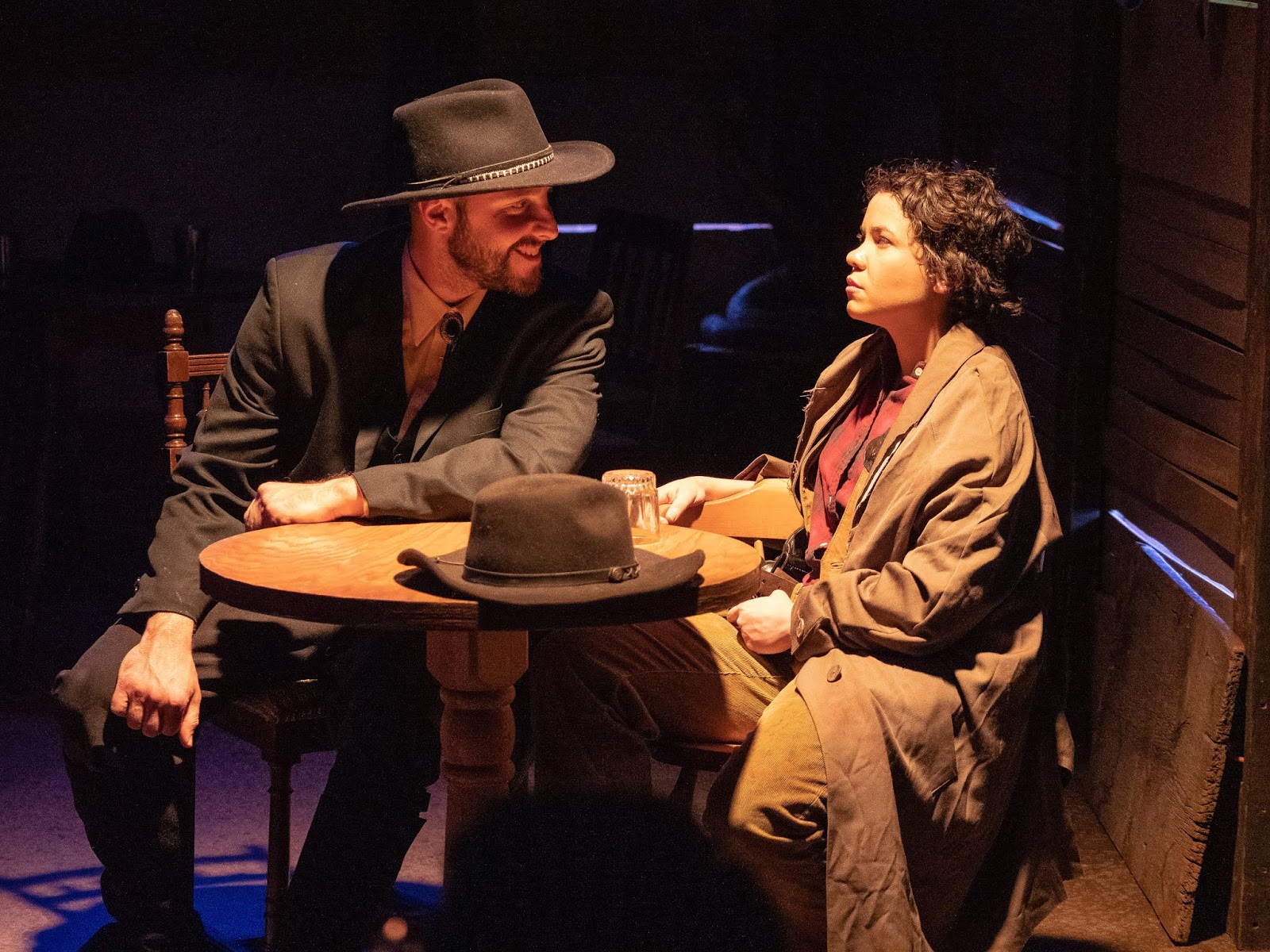
Once upon a time I went to a show and it was called Hell Followed With Her. It was written by Bill Daniel and directed by Josh Zagoren. It was about a woman named Willow (Sophia Rosado) who comes to the town of Dodge, Texas looking for a criminal on the run, Glanton (George Zarante). The people in the saloon she has walked into notice that she is a bit unusual, but they all have secrets of their own. As a zombie plague infects the town, the saloon-goers slowly notice the strange happenings and become more involved with them than they ever wanted. The show is about strangers, revenge, and having to make difficult choices. I think this is an intriguing concept with some unforgettable characters.

The atmosphere at Wild Claw shows is always very immersive. From the second you walk into the space you really feel the dread and terror that is to come. By the time you walk through the hallway into the onstage saloon, many of the actors already were on stage drinking and talking. The set (co-designed by Rachel Watson and Greg Williamson) had a natural chaos about it. The tables didn't seem to be in their original places but everyone seemed used to it. Maybe there had been a bar fight three years ago and all the tables got pushed to the side and no one ever put them back because they didn't care about it. The lighting (Conchita Avitia) was very dark and natural to the location. The costumes (Satoe Schechner) seemed very lived-in which was perfect for the outlaw vibe of every character. Even if they weren't all technically outlaws, they sure dressed like them.

One of my favorite characters was Shelby (Nora King), who was part of Glanton's clan. She frequently had witty interjections that I was always looking forward to. This character was blind and was a lot smarter than people took her for. She knew a lot about being a criminal and guns and it was funny to see everyone's reaction to her extensive knowledge. Another character I really liked was Cole (Josh Razavi when I saw it, usually Ardarius Blakely). He was a very stoic man; he didn't talk or move for a good chunk of the first act. He seemed to have a soft spot for Willow and he didn't seem to want to hurt anyone, despite coming off as a tough guy. Denton (Gregory Madden) was the sheriff and genuinely seemed like a good person. He was the only person who from start to finish seemed to be doing everything for the greater good. In a show with zombies and outlaws, I think a stable presence whose motive is keeping peace is something that is welcome. I wish I had known more about these characters; I would have enjoyed more in-depth explorations of a few characters instead of having little bits about a very large cast of characters.

This show had gender-blind casting, which is something I usually like in a show because it gives opportunities to gender nonconforming folks and women in shows with largely male casts, which are a lot of shows in the history of theater. I think this play wanted to be feminist and inclusive. It features a strong female central character and a majority non-male-identifying cast. But the majority of the characters in the show were male-identifying, even when played by women and people who were gender nonconforming. They are not telling many female stories, and the one major female story that they tell ends up turning into a straight romance, when the story didn't need it. It would be an interesting town if the characters who had traditionally male pursuits in the time period (and were played by non-male actors) were women and nonconforming characters. I know sometimes scripts can't be changed, but since this was a world premiere, maybe it could have been revised to better reflect the casting or clarify why most of the characters had to be male.

People who would like this show are people who like westerns, immersive atmosphere, and zombie bar fights. I think this is a cool show. It is perfect if you are in a spooky mood.

Photos: Clark Bender/WildClaw Theatre

Friday, October 11, 2019

Review of Promethean Theatre Ensemble's Blue Stockings

Once upon a time I went to a show and it was called Blue Stockings. It was by Jessica Swale and it was directed by Spenser Davis. It was about a group of girls in the late nineteenth century at Girton College in Cambridge, who were very controversial for their time because women were not yet given the right to graduate with degrees from Cambridge. It is about choosing between knowledge and romance, threats to female friendship, and self-worth. I think this is an intriguing idea for a show, and it was interesting to learn about these women characters.

I noticed how the women students at Girton--Tess (Heather Kae Smith), Celia (Julia Rowley), Maeve (Imani Lyvette), and Carolyn (Elise Marie Davis)--seemed to be using men's words (in the form of quotation) to make their points in class. It shows that all of the ideas that were respected by society in that time were the ideas of men. By the end they begin to express their own theories and ideas, moving from quotation to contradiction of male theories. They are led to this new way of thinking by their teacher, Miss Blake (Cameron Feagin), who showed them their ideas were just as smart if not smarter than any man's and that they had a right to express them. We see the male students drinking and having fun, while the women have to work five times as hard to try to gain access to (but probably not even get) the achievements that the boys are getting. While all the women are working their butts off, the men are drunkenly proclaiming that women will never be as smart as men are.

I thought the female friendships were very compelling, but I would have liked to have seen more attention paid to them. The female friendships were what I found most interesting, but the play spends a lot of time focused on the men and how misogynistic they are instead of giving the female characters more stage time and character development. The most compelling moments were moments of human connection like when Tess was having a breakdown because she was too focused on her relationship on a boy from another college in the university and wasn't paying attention to her studies. Tess starts to open up to Celia about how she thinks she will never succeed so it seems useless to try. This was one of my favorite moments in the show because you get to see Celia grow because she starts to help Tess in an authoritative way, which we haven't seen from her. Celia always seemed afraid of her brain power and wants to make herself smaller. But in this moment she sees Tess in need and she is propelled by that moment to be brutally honest, talk about herself, and give advice in a unapologetic way. I was sad that the first act ended with the permanent departure of my favorite character, Maeve, because she seemed to be the most mature, intelligent, and likable character in the show. She has to return home to care for her family because the head of Girton, Elizabeth Welsh (Jamie Bragg) believes that appearances are more important than the actual education of women. She is obsessed with getting men's approval for her college, and to do that, women have to appear to value traditional female roles and duties over their education.

I found the focus of the play inconsistent in an unhelpful way, especially in the second act because it shifted its focus from the relationships within Girton to the men and their place in the lives of the women. And at the end, after focusing on a fictional love triangle (between Tess, Ralph [Kevin Sheehan], and Will [Martin Diaz-Valdes]), the play tries to tie it all up like the end of a documentary. I was also disappointed in how the climactic scene of the play featured pretty much only monologues from men, as if the play is more interested in the male view of the situation even though we already know these men's views from earlier in the play. Their pitying apologies weren't convincing at all to me. I'm not sure they were supposed to be, but I was't sure why such meaty monologues were needed if we weren't supposed to be convinced.

People who would like this show are people who like learning about feminism, historical fiction, and drunken male proclamations. I think this is an interesting topic for a show. It has inspired me to look more into this time in history and learn more about the lives of women pursuing education and advancement.

Photos: Tom McGrath, TCMcG Photography